
http://www.thehistoryofenglish.com/issues_new.html
By Creating from Scratch

Many of the new words added to the ever-growing lexicon of the English language are just created from scratch, and often have little or no etymological pedigree. A good example is the word dog, etymologically unrelated to any other known word, which, in the late Middle Ages, suddenly and mysteriously displaced the Old English word hound (or hund) which had served for centuries. Some of the commonest words in the language arrived in a similarly inexplicable way (e.g. jaw, askance, tantrum, conundrum, bad, big, donkey, kick, slum, log, dodge,fuss, prod, hunch, freak, bludgeon, slang, puzzle, surf, pour, slouch, bash, etc.).
Words like gadget, blimp, raunchy, scam, nifty, zit, clobber, gimmick, jazz and googol have all appeared in the last century or two with no apparent etymology, and are more recent examples of this kind of novel creation of words. Additionally, some words that have existed for centuries in regional dialects or as rarely used terms, suddenly enter into popular use for little or no apparent reason (e.g. scrounge and seep, both old but obscure English words, suddenly came into general use in the early 20th Century).
Sometimes, if infrequently, a “nonce word” (created “for the nonce”, and not expected to be re-used or generalized) does become incorporated into the language. One example is James Joyce’s invention quark, which was later adopted by the physicist Murray Gell-Mann to name a new class of sub-atomic particle, and another isblurb, which dates back to 1907.
By Adoption or Borrowing
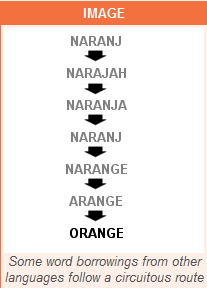
Loanwords, or borrowings, are words which are adopted into a native language from a different source language. Such borrowings have shaped the English language almost from its beginnings, as words were adopted from the classical languages as well as from successive wave of invasions (e.g. Vikings, Normans). Even by the 16th Century, long before the British Empire extended its capacious reach around the world, English had already adopted words from an estimated 50 other languages, and the vast majority of English words today are actually foreign borrowings of one sort or another.
Sometimes these adoptions have come by a circuitous route (e.g. the word orange originated with the Sanskrit naranj or naranga or narangaphalam or naragga, which became the Arabic naranjah and the Spanish naranja, entered English as a naranj, changed to a narange, then to an arange and finally an orange; the word garbage came to English originally from Latin, but only arrived via Old Italian, an Italian dialect and then Norman French). Sometimes the tortuous route and degrees of filtering through other languages can modify words so much that their original derivations are all but indiscernible (e.g. both coy and quiet come from the Latin word quietus;sordid and swarthy both come from the Latin sordere; entirety and integrity both derive from the Latin integritas; salary and sausage both originate with the Latin word sal; grammar and glamour are both descended from the same Greek word gramma; and gentle, gentile, genteel and jaunty all come from the Latin gentilis; etc).
Since the expansion of global trade, and particularly since British colonialism opened up rich new sources a huge number of words have been adopted into English from a great diversity of different languages. In a reverse process, many English words have also been adopted by other countries.
By Adding Prefixes and Suffixes
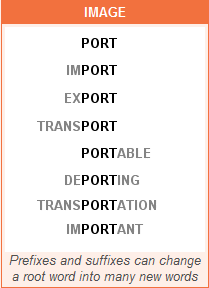
The ability to add affixes, whether prefixes (e.g. com-, con-, de-, ex-, inter-, pre-, pro-, re-, sub-, un-, etc) and suffixes (e.g. -al, -ence, -er, -ment, -ness, -ship, -tion, -ate, -ed, -ize, -able, -ful, -ous, -ive, -ly, -y, etc) makes English extremely flexible. This process, referred to as agglutination, is a simple way to completely alter or subtly revise the meanings of existing words, to create other parts of speech out of words (e.g. verbs from nouns, adverbs form adjectives, etc.), or to create completely new words from new roots. There are very few rules in the addition of affixes in English, and Anglo-Saxon affixes can be attached to Latin or Greek roots, or vice versa. An extreme example is the word incomprehensibility, which is based on the simple root -hen- (original from Indo-European root word ghend- meaning to grasp or seize) with no less than 5 affixes: in- (not), com- (with), pre- (before), -ible(capable) and -ity (being).
However, the sheer variety and number of possible affixes in English can lead to some confusion. For instance, there is no single standard method for something as basic as making a noun into an adjective (-able, -al, -ous and-y are just some of the possibilities). There are at least nine different negation prefixes (a-, anti-, dis-, il-, im-, in-,ir-, non- and un-), and it is almost impossible for a non-native speaker to predict which is to be used with which root word. To make matters worse, some apparently negative forms do not even negate the meanings of their roots (e.g. flammable and inflammable, habitable and inhabitable, ravel and unravel).
Some affix additions are surprisingly recent. Officialdom and boredom joined the ancient word kingdom as recently as the 20th Century, and apolitical as the negation of political did not appear until 1952. Adding affixes remains the simplest and perhaps the commonest method of creating new words.
By Truncation or Clipping
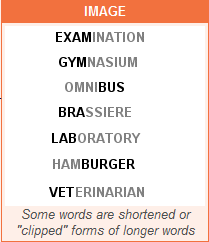
Some words arise simply as shortened forms of longer words (exam, gym, lab, bus, vet, fridge, bra, pram, phoneand burger are some obvious and well-used examples). Perhaps less obvious is the derivation of words like mob(from the Latin phrase mobile vulgus, meaning a fickle crowd), goodbye (a shortening of God-be-with-you) andhello (a shortened form of the Old English for “whole be thou”).
Leaving aside the common English practice of contracting multiple words like do not, you are, there will and that would into the single words don’t, you’re, there’ll and that’d, there are many other examples where multiple words or phrases have been contracted into single words (e.g. daisy was once a flower called day’s eye; shepherd was sheep herd; lord was originally loaf-ward; fortnight was fourteen-night; etc.).
Acronyms are another example of this technique. While most acronyms (e.g. USA, IMF, OPEC, etc.) remain as just a series of initial letters, some have been formed into words (e.g. laser from light amplification by stimulated emission of radiation, radar from radio detection and ranging); quasar from quasi-stellar radio source; scuba from self-contained underwater breathing apparatus; etc).
By Fusing or Compounding Existing Words
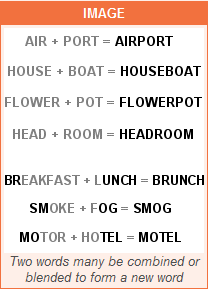
Like many languages, English allows the formation of compound words by fusing together shorter words (e.g.airport, seashore, fireplace, footwear, wristwatch, landmark, flowerpot, etc), although it is not taken to the extremes of German or Dutch where extremely long and unwieldy word chains are commonplace. The concatenation of words in English may even allow for different meanings depending on the order of combination (e.g. houseboat/boathouse, basketwork/workbasket, casebook/bookcase, etc.).
The root words may be run together with no separation (as in the examples above), or they may be hyphenated (e.g. self-discipline, part-time, mother-in-law) or even left as separate words (e.g. fire hydrant, commander in chief), although the rules for such constructions are unclear at best.
During the English Renaissance and the Industrial Revolution, compounding classical elements of Greek and Latin (e.g. photograph, telephone, etc.) was a very common method of English word formation, and the process continues even today. A large part of the scientific and technical lexicon of English consists of such classical compounds.
Sometimes words or phonemes are blended rather than combined whole, forming a “portmanteau word” with two meanings packed into one word, or with a meaning intermediate between the two constituent words (e.g. brunch, which blends breakfast and lunch; motel, which blends motor and hotel; electrocute, which blends electric and execute; smog, which blends smoke and fog; guesstimate, which blends guess and estimate; telethon, which blends telephone and marathon; chocoholic, which blends chocolate and alcoholic; etc.). Lewis Carroll was perhaps the first to deliberately use this technique for literary effect, when he introduced new words like slithy, frumious, galumph, etc., in his poetry in the 19th Century.
By Changing the Meaning of Existing Words

The drift of word meanings over time often arises, often but not always due to catachresis (the misuse, either deliberate or accidental, of words). By some estimates, over half of all words adopted into English from Latin have changed their meaning in some way over time, often drastically. For example, smart originally meant sharp, cutting or painful; handsome merely meant easily-handled (and was generally derogatory); bully originally meant darling or sweetheart; sad meant full, satiated or satisfied; and insult meant to boast, brag or triumph in an insolent way. A more modern example is the changing meaning of gay from merry to homosexual (and, in some circles in more recent years, to stupid or bad).
Some words have changed their meanings many times. Nice originally meant stupid or foolish; then, for a time, it came to mean lascivious or wanton; it then went through a whole host of alternative meanings (including extravagant, elegant, strange, slothful, unmanly, luxurious, modest, slight, precise, thin, shy, discriminating and dainty), before settling down into its modern meaning of pleasant and agreeable in the late 18th Century. Conversely, silly originally meant blessed or happy, and then passed through intermediate meanings of pious, innocent, harmless, pitiable, feeble and feeble-minded, before finally ending up as foolish or stupid. Buxom originally meant obedient to God in Middle English, but it passed through phases of meaning humble and submissive, obliging and courteous, ready and willing, bright and lively, and healthy and vigorous, before settling on its current very specific meaning relating to a plump and well-endowed woman.
Some words have become much more specific than their original meanings. For instance, starve originally just mean to die, but is now much more specific; a forest was originally any land used for hunting, regardless of whether it was covered in trees; deer once referred to any animal, not just the specific animal we now associate with the word; girl was once a young person of either sex; and meat originally covered all kinds of food (as in the phrase “meat and drink”).
Some words came to mean almost the complete opposite of their original meanings. For instance, counterfeit used to mean a legitimate copy; brave once implied cowardice; crafty was originally a term of praise; cute used to mean bow-legged; enthusiasm and zeal were both once disparaging words;manufacture originally meant to make by hand; awful meant deserving of awe; egregious originally connoted eminent or admirable; artificial was a positive description meaning full of skillful artifice; etc.
A related category is where an existing word comes to be used with another grammatical function, often a different part of speech, a process known as functional shift. Examples include: the creation of the nouns a commute, a bore and a swim from the original verbs to commute, to bore and to swim; the creation of the verbs to bottle, to catalogue and to text from the original nouns bottle, catalogue and text; the creation of the verbs to dirty, to empty and to dry from the original adjectives dirty, empty and dry, etc. Modern language purists often condemn such developments, although they have occurred throughout the history of English, and in some cases may even reclaim the original sense of a word (e.g. impact was originally introduced as a verb, then established itself predominantly as a noun, and has only recently begun to be used a verb once more).
By Errors

According to the “Oxford English Dictionary”, there are at least 350 words in English dictionaries (most of them thankfully quite obscure) that owe their existence purely to typographical errors or other misrenderings.
There are many more words, often in quite common use, that have arisen over time due to mishearings (e.g.shamefaced from the original shamefast, penthouse from pentice, sweetheart from sweetard, buttonhole frombutton-hold, etc.).
Mrs. Mapalprop, a character in Richard Brinsley Sheridan’s 1775 play “The Rivals”, was famous for her “malapropisms” like illiterate, reprehend, etc, but these never gained common currency. Likewise, it seems unlikely that “Bushisms” (named for US President Bush’s unfortunate tendency to mangle the language) like misunderestimate, or Sarah Palin’s refudiate will ever become part of the everyday language, although there are many who would argue that they deserve to.
Many misused words (as opposed to newly-coined words) have, for better or worse, become so widely used in their new context that they may be considered to be generally accepted, particularly in the USA, although many strict grammarians insist on their distinctness (e.g. alternate to mean alternative, momentarily to mean presently, disinterested to mean uninterested,i.e. to mean e.g., flaunt to mean flout, historic to mean historical, imply to mean infer, etc.).
By Back-Formation

Some words are “back-formed”, where a new word is formed by removing an actual, or often just a supposed or incorrectly identified, affix. A good example of back-formation is the old word pease, which was mistakenly assumed to be a plural, and thus led to the creation of a new “singular” word, pea. Similarly, asset was back-formed from the singular noun assets (originally from the Anglo-Norman asetz).
More often, though, a new word for a different part of speech is derived form an older form (e.g. laze from lazy, beg from beggar, greed from greedy, rove from rover, burgle from burglar, edit from editor, difficult from difficulty,resurrect from resurrection, insert from insertion, project from projection, grovel from groveling, sidle from sidelingor sidelong, etc).
By Imitation of Sounds

Words may be formed by the deliberate imitation of sounds they describe (onomatopoeia). Often this kind of onomatopoeic formation is surprisingly ancient, and Old English literature is usually described as highly onomatopoeic, alliterative and percussive. Sometimes, the imitation may have originally occurred in a source language, and only later borrowed into English, and by its very nature sound imitation tends to result in similar cognates in several languages. Some philologists have suggested that the first human languages developed as imitations of natural sounds (so-called “bow-wow theories”), and imitative abilities certainly seem to have played some role in the evolution of language.
Examples include boo, bow-wow, tweet, boom, tinkle, rattle, buzz, click, hiss, bang, plop, cuckoo, quack, beep, etc., but there are many many more. Some words, like squirm for example, are not strictly onomatopoeic but are nevertheless imitative to some extent (e.g like a worm)
By Transfer of Proper Nouns
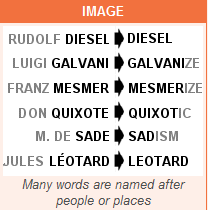
A surprising number of words have been created by the transfer of the proper names of people, places and things into words which then become part of the generalized vocabulary of the language, also known as eponyms. Examples include maverick (after the American cattleman, Samuel Augustus Maverick); saxophone (after the Belgian musical-instrument maker, Adolphe Sax); quisling (after the pro-Nazi Norwegian leader, Vidkun Quisling);sandwich (after the fourth Earl of Sandwich); silhouette (after the French finance minister, Etienne de Silhouette);kafkaesque (after the Czech novelist, Franz Kafka); quixotic (after the romantic, impractical hero of a Cervantes novel); boycott (after Charles Boycott, the shunned Irish land agent for an absentee landlord); etc. Other common eponyms include biro, bloomers, boffin, chauvinism, diesel, galvanize, guillotine, leotard, lesbian, lynch,marathon, mesmerize, odyssey, sadism, shrapnel, spartan, teddy, wellington, etc.
Many terms for political, philosophical or religious doctrines are based on the names of their founders or chief exponents (e.g. Marxism, Aristotelianism, Platonic, stoic, Christianity, etc.). Similarly, many scientific terms and units of measurement are named after their inventors (e.g. ampere, angstrom, joule, watt, etc). Increasingly, in the 20th Century, specific brand names have become generalized descriptions (e.g. hoover, kleenex, xerox, aspirin, google, etc.).
Sometimes, portmanteau words may be produced by joining together proper nouns with common nouns, such as in the case of gerrymandering, a word combining the politically-contrived re-districting practices of Massachusetts Governor Elbridge Gerry with the salamander-shaped outline one of the districts he created.


 Over the last few decades, miners in South Africa have been digging up mysterious metal spheres. Origin unknown, these spheres measure approximately an inch or so in diameter, and some are etched with three parallel grooves running around the equator. Two types of spheres have been found: one is composed of a solid bluish metal with flecks of white; the other is hollowed out and filled with a spongy white substance. The kicker is that the rock in which they where found is Precambrian – and dated to 2.8 billion years old! Who made them and for what purpose is unknown.
  In 1938, an archeological expedition led by Dr. Chi Pu Tei into the Baian-Kara-Ula mountains of China made an astonishing discovery in some caves that had apparently been occupied by some ancient culture. Buried in the dust of ages on the cave floor were hundreds of stone disks. Measuring about nine inches in diameter, each had a circle cut into the center and was etched with a spiral groove, making it look for all the world like some ancient phonograph record some 10,000 to 12,000 years old. The spiral groove, it turns out, is actually composed of tiny hieroglyphics that tell the incredible story of spaceships from some distant world that crash-landed in the mountains. The ships were piloted by people who called themselves the Dropa, and the remains of whose descendents, possibly, were found in the cave.


 There are artifacts belonging to ancient Egyptian and Central American cultures that look amazingly like modern-day aircraft. The Egyptian artifact, found in a tomb at Saqquara, Egypt in 1898, is a six-inch wooden object that strongly resembles a model airplane, with fuselage, wings and tail. Experts believe the object is so aerodynamic that it is actually able to glide. The small object discovered in Central America (shown at right), and estimated to be 1,000 years old, is made of gold and could easily be mistaken for a model of a delta-wing aircraft – or even the Space Shuttle. It even features what looks like a pilot’s seat.
 Fossils, as we learned in grade school, appear in rocks that were formed many thousands of years ago. Yet there are a number of fossils that just don’t make geological or historical sense. A fossil of ahuman handprint, for example, was found in limestone estimated to be 110 million years old. What appears to be a fossilizedhuman finger found in the Canadian Arctic also dates back 100 to 110 million years ago. And what appears to be the fossil of ahuman footprint, possibly wearing a sandal, was found near Delta, Utah in a shale deposit estimated to be 300 million to 600 million years old.
  Humans were not even around 65 million years ago, never mind people who could work metal. So then how does science explain semi-ovoid metallic tubes dug out of 65-million-year-old Cretaceous chalk in France? In 1885, a block of coal was broken open to find a metal cube obviously worked by intelligent hands. In 1912, employees at an electric plant broke apart a large chunk of coal out of which fell an iron pot! A nail was found embedded in a sandstone block from the Mesozoic Era. And there are many, many more such anomalies.
  Poon Lim, a Chinese seaman, held the world’s record as a sea survivor after floating alone on a life raft in the South Atlantic for 133 days. When told of the record, he said, “ I hope no one will ever have to break it.”
 Tarun's Blog