
Microsoft ditched the live spaces service so moved the blog to WordPress!
Tarun Rattan
Microsoft ditched the live spaces service so moved the blog to WordPress!
Tarun Rattan
In particular, Whorf announced, Native American languages impose on their speakers a picture of reality that is totally different from ours, so their speakers would simply not be able to understand some of our most basic concepts, like the flow of time or the distinction between objects (like “stone”) and actions (like “fall”). For decades, Whorf’s theory dazzled both academics and the general public alike. In his shadow, others made a whole range of imaginative claims about the supposed power of language, from the assertion that Native American languages instill in their speakers an intuitive understanding of Einstein’s concept of time as a fourth dimension to the theory that the nature of the Jewish religion was determined by the tense system of ancient Hebrew.
Eventually, Whorf’s theory crash-landed on hard facts and solid common sense, when it transpired that there had never actually been any evidence to support his fantastic claims. The reaction was so severe that for decades, any attempts to explore the influence of the mother tongue on our thoughts were relegated to the loony fringes of disrepute. But 70 years on, it is surely time to put the trauma of Whorf behind us. And in the last few years, new research has revealed that when we learn our mother tongue, we do after all acquire certain habits of thought that shape our experience in significant and often surprising ways.
Whorf, we now know, made many mistakes. The most serious one was to assume that our mother tongue constrains our minds and prevents us from being able to think certain thoughts. The general structure of his arguments was to claim that if a language has no word for a certain concept, then its speakers would not be able to understand this concept. If a language has no future tense, for instance, its speakers would simply not be able to grasp our notion of future time. It seems barely comprehensible that this line of argument could ever have achieved such success, given that so much contrary evidence confronts you wherever you look. When you ask, in perfectly normal English, and in the present tense, “Are you coming tomorrow?” do you feel your grip on the notion of futurity slipping away? Do English speakers who have never heard the German word Schadenfreude find it difficult to understand the concept of relishing someone else’s misfortune? Or think about it this way: If the inventory of ready-made words in your language determined which concepts you were able to understand, how would you ever learn anything new?
SINCE THERE IS NO EVIDENCE that any language forbids its speakers to think anything, we must look in an entirely different direction to discover how our mother tongue really does shape our experience of the world. Some 50 years ago, the renowned linguist Roman Jakobson pointed out a crucial fact about differences between languages in a pithy maxim: “Languages differ essentially in what they must convey and not in what they may convey.” This maxim offers us the key to unlocking the real force of the mother tongue: if different languages influence our minds in different ways, this is not because of what our language allows us to think but rather because of what it habitually obliges us to think about.
Consider this example. Suppose I say to you in English that “I spent yesterday evening with a neighbor.” You may well wonder whether my companion was male or female, but I have the right to tell you politely that it’s none of your business. But if we were speaking French or German, I wouldn’t have the privilege to equivocate in this way, because I would be obliged by the grammar of language to choose between voisin or voisine;Nachbar or Nachbarin. These languages compel me to inform you about the sex of my companion whether or not I feel it is remotely your concern. This does not mean, of course, that English speakers are unable to understand the differences between evenings spent with male or female neighbors, but it does mean that they do not have to consider the sexes of neighbors, friends, teachers and a host of other persons each time they come up in a conversation, whereas speakers of some languages are obliged to do so.
On the other hand, English does oblige you to specify certain types of information that can be left to the context in other languages. If I want to tell you in English about a dinner with my neighbor, I may not have to mention the neighbor’s sex, but I do have to tell you something about the timing of the event: I have to decide whether we dined, have been dining, are dining, will be dining and so on. Chinese, on the other hand, does not oblige its speakers to specify the exact time of the action in this way, because the same verb form can be used for past, present or future actions. Again, this does not mean that the Chinese are unable to understand the concept of time. But it does mean they are not obliged to think about timing whenever they describe an action.
When your language routinely obliges you to specify certain types of information, it forces you to be attentive to certain details in the world and to certain aspects of experience that speakers of other languages may not be required to think about all the time. And since such habits of speech are cultivated from the earliest age, it is only natural that they can settle into habits of mind that go beyond language itself, affecting your experiences, perceptions, associations, feelings, memories and orientation in the world.
BUT IS THERE any evidence for this happening in practice?
Let’s take genders again. Languages like Spanish, French, German and Russian not only oblige you to think about the sex of friends and neighbors, but they also assign a male or female gender to a whole range of inanimate objects quite at whim. What, for instance, is particularly feminine about a Frenchman’s beard (la barbe)? Why is Russian water a she, and why does she become a he once you have dipped a tea bag into her? Mark Twain famously lamented such erratic genders as female turnips and neuter maidens in his rant “The Awful German Language.” But whereas he claimed that there was something particularly perverse about the German gender system, it is in fact English that is unusual, at least among European languages, in not treating turnips and tea cups as masculine or feminine. Languages that treat an inanimate object as a he or a she force their speakers to talk about such an object as if it were a man or a woman. And as anyone whose mother tongue has a gender system will tell you, once the habit has taken hold, it is all but impossible to shake off. When I speak English, I may say about a bed that “it” is too soft, but as a native Hebrew speaker, I actually feel “she” is too soft. “She” stays feminine all the way from the lungs up to the glottis and is neutered only when she reaches the tip of the tongue.
In recent years, various experiments have shown that grammatical genders can shape the feelings and associations of speakers toward objects around them. In the 1990s, for example, psychologists compared associations between speakers of German and Spanish. There are many inanimate nouns whose genders in the two languages are reversed. A German bridge is feminine (die Brücke), for instance, but el puente is masculine in Spanish; and the same goes for clocks, apartments, forks, newspapers, pockets, shoulders, stamps, tickets, violins, the sun, the world and love. On the other hand, an apple is masculine for Germans but feminine in Spanish, and so are chairs, brooms, butterflies, keys, mountains, stars, tables, wars, rain and garbage. When speakers were asked to grade various objects on a range of characteristics, Spanish speakers deemed bridges, clocks and violins to have more “manly properties” like strength, but Germans tended to think of them as more slender or elegant. With objects like mountains or chairs, which are “he” in German but “she” in Spanish, the effect was reversed.
In a different experiment, French and Spanish speakers were asked to assign human voices to various objects in a cartoon. When French speakers saw a picture of a fork (la fourchette), most of them wanted it to speak in a woman’s voice, but Spanish speakers, for whom el tenedor is masculine, preferred a gravelly male voice for it. More recently, psychologists have even shown that “gendered languages” imprint gender traits for objects so strongly in the mind that these associations obstruct speakers’ ability to commit information to memory.
Of course, all this does not mean that speakers of Spanish or French or German fail to understand that inanimate objects do not really have biological sex — a German woman rarely mistakes her husband for a hat, and Spanish men are not known to confuse a bed with what might be lying in it. Nonetheless, once gender connotations have been imposed on impressionable young minds, they lead those with a gendered mother tongue to see the inanimate world through lenses tinted with associations and emotional responses that English speakers — stuck in their monochrome desert of “its” — are entirely oblivious to. Did the opposite genders of “bridge” in German and Spanish, for example, have an effect on the design of bridges in Spain and Germany? Do the emotional maps imposed by a gender system have higher-level behavioral consequences for our everyday life? Do they shape tastes, fashions, habits and preferences in the societies concerned? At the current state of our knowledge about the brain, this is not something that can be easily measured in a psychology lab. But it would be surprising if they didn’t.
The area where the most striking evidence for the influence of language on thought has come to light is the language of space — how we describe the orientation of the world around us. Suppose you want to give someone directions for getting to your house. You might say: “After the traffic lights, take the first left, then the second right, and then you’ll see a white house in front of you. Our door is on the right.” But in theory, you could also say: “After the traffic lights, drive north, and then on the second crossing drive east, and you’ll see a white house directly to the east. Ours is the southern door.” These two sets of directions may describe the same route, but they rely on different systems of coordinates. The first uses egocentric coordinates, which depend on our own bodies: a left-right axis and a front-back axis orthogonal to it. The second system uses fixed geographic directions, which do not rotate with us wherever we turn.
We find it useful to use geographic directions when hiking in the open countryside, for example, but the egocentric coordinates completely dominate our speech when we describe small-scale spaces. We don’t say: “When you get out of the elevator, walk south, and then take the second door to the east.” The reason the egocentric system is so dominant in our language is that it feels so much easier and more natural. After all, we always know where “behind” or “in front of” us is. We don’t need a map or a compass to work it out, we just feel it, because the egocentric coordinates are based directly on our own bodies and our immediate visual fields.
But then a remote Australian aboriginal tongue, Guugu Yimithirr, from north Queensland, turned up, and with it came the astounding realization that not all languages conform to what we have always taken as simply “natural.” In fact, Guugu Yimithirr doesn’t make any use of egocentric coordinates at all. The anthropologist John Haviland and later the linguist Stephen Levinson have shown that Guugu Yimithirr does not use words like “left” or “right,” “in front of” or “behind,” to describe the position of objects. Whenever we would use the egocentric system, the Guugu Yimithirr rely on cardinal directions. If they want you to move over on the car seat to make room, they’ll say “move a bit to the east.” To tell you where exactly they left something in your house, they’ll say, “I left it on the southern edge of the western table.” Or they would warn you to “look out for that big ant just north of your foot.” Even when shown a film on television, they gave descriptions of it based on the orientation of the screen. If the television was facing north, and a man on the screen was approaching, they said that he was “coming northward.”
When these peculiarities of Guugu Yimithirr were uncovered, they inspired a large-scale research project into the language of space. And as it happens, Guugu Yimithirr is not a freak occurrence; languages that rely primarily on geographical coordinates are scattered around the world, from Polynesia to Mexico, from Namibia to Bali. For us, it might seem the height of absurdity for a dance teacher to say, “Now raise your north hand and move your south leg eastward.” But the joke would be lost on some: the Canadian-American musicologist Colin McPhee, who spent several years on Bali in the 1930s, recalls a young boy who showed great talent for dancing. As there was no instructor in the child’s village, McPhee arranged for him to stay with a teacher in a different village. But when he came to check on the boy’s progress after a few days, he found the boy dejected and the teacher exasperated. It was impossible to teach the boy anything, because he simply did not understand any of the instructions. When told to take “three steps east” or “bend southwest,” he didn’t know what to do. The boy would not have had the least trouble with these directions in his own village, but because the landscape in the new village was entirely unfamiliar, he became disoriented and confused. Why didn’t the teacher use different instructions? He would probably have replied that saying “take three steps forward” or “bend backward” would be the height of absurdity.
So different languages certainly make us speak about space in very different ways. But does this necessarily mean that we have to think about space differently? By now red lights should be flashing, because even if a language doesn’t have a word for “behind,” this doesn’t necessarily mean that its speakers wouldn’t be able to understand this concept. Instead, we should look for the possible consequences of what geographic languages obligetheir speakers to convey. In particular, we should be on the lookout for what habits of mind might develop because of the necessity of specifying geographic directions all the time.
In order to speak a language like Guugu Yimithirr, you need to know where the cardinal directions are at each and every moment of your waking life. You need to have a compass in your mind that operates all the time, day and night, without lunch breaks or weekends off, since otherwise you would not be able to impart the most basic information or understand what people around you are saying. Indeed, speakers of geographic languages seem to have an almost-superhuman sense of orientation. Regardless of visibility conditions, regardless of whether they are in thick forest or on an open plain, whether outside or indoors or even in caves, whether stationary or moving, they have a spot-on sense of direction. They don’t look at the sun and pause for a moment of calculation before they say, “There’s an ant just north of your foot.” They simply feel where north, south, west and east are, just as people with perfect pitch feel what each note is without having to calculate intervals. There is a wealth of stories about what to us may seem like incredible feats of orientation but for speakers of geographic languages are just a matter of course. One report relates how a speaker of Tzeltal from southern Mexico was blindfolded and spun around more than 20 times in a darkened house. Still blindfolded and dizzy, he pointed without hesitation at the geographic directions.
How does this work? The convention of communicating with geographic coordinates compels speakers from the youngest age to pay attention to the clues from the physical environment (the position of the sun, wind and so on) every second of their lives, and to develop an accurate memory of their own changing orientations at any given moment. So everyday communication in a geographic language provides the most intense imaginable drilling in geographic orientation (it has been estimated that as much as 1 word in 10 in a normal Guugu Yimithirr conversation is “north,” “south,” “west” or “east,” often accompanied by precise hand gestures). This habit of constant awareness to the geographic direction is inculcated almost from infancy: studies have shown that children in such societies start using geographic directions as early as age 2 and fully master the system by 7 or 8. With such an early and intense drilling, the habit soon becomes second nature, effortless and unconscious. When Guugu Yimithirr speakers were asked how they knew where north is, they couldn’t explain it any more than you can explain how you know where “behind” is.
But there is more to the effects of a geographic language, for the sense of orientation has to extend further in time than the immediate present. If you speak a Guugu Yimithirr-style language, your memories of anything that you might ever want to report will have to be stored with cardinal directions as part of the picture. One Guugu Yimithirr speaker was filmed telling his friends the story of how in his youth, he capsized in shark-infested waters. He and an older person were caught in a storm, and their boat tipped over. They both jumped into the water and managed to swim nearly three miles to the shore, only to discover that the missionary for whom they worked was far more concerned at the loss of the boat than relieved at their miraculous escape. Apart from the dramatic content, the remarkable thing about the story was that it was remembered throughout in cardinal directions: the speaker jumped into the water on the western side of the boat, his companion to the east of the boat, they saw a giant shark swimming north and so on. Perhaps the cardinal directions were just made up for the occasion? Well, quite by chance, the same person was filmed some years later telling the same story. The cardinal directions matched exactly in the two tellings. Even more remarkable were the spontaneous hand gestures that accompanied the story. For instance, the direction in which the boat rolled over was gestured in the correct geographic orientation, regardless of the direction the speaker was facing in the two films.
Psychological experiments have also shown that under certain circumstances, speakers of Guugu Yimithirr-style languages even remember “the same reality” differently from us. There has been heated debate about the interpretation of some of these experiments, but one conclusion that seems compelling is that while we are trained to ignore directional rotations when we commit information to memory, speakers of geographic languages are trained not to do so. One way of understanding this is to imagine that you are traveling with a speaker of such a language and staying in a large chain-style hotel, with corridor upon corridor of identical-looking doors. Your friend is staying in the room opposite yours, and when you go into his room, you’ll see an exact replica of yours: the same bathroom door on the left, the same mirrored wardrobe on the right, the same main room with the same bed on the left, the same curtains drawn behind it, the same desk next to the wall on the right, the same television set on the left corner of the desk and the same telephone on the right. In short, you have seen the same room twice. But when your friend comes into your room, he will see something quite different from this, because everything is reversed north-side-south. In his room the bed was in the north, while in yours it is in the south; the telephone that in his room was in the west is now in the east, and so on. So while you will see and remember the same room twice, a speaker of a geographic language will see and remember two different rooms.
It is not easy for us to conceive how Guugu Yimithirr speakers experience the world, with a crisscrossing of cardinal directions imposed on any mental picture and any piece of graphic memory. Nor is it easy to speculate about how geographic languages affect areas of experience other than spatial orientation — whether they influence the speaker’s sense of identity, for instance, or bring about a less-egocentric outlook on life. But one piece of evidence is telling: if you saw a Guugu Yimithirr speaker pointing at himself, you would naturally assume he meant to draw attention to himself. In fact, he is pointing at a cardinal direction that happens to be behind his back. While we are always at the center of the world, and it would never occur to us that pointing in the direction of our chest could mean anything other than to draw attention to ourselves, a Guugu Yimithirr speaker points through himself, as if he were thin air and his own existence were irrelevant.
IN WHAT OTHER WAYS might the language we speak influence our experience of the world? Recently, it has been demonstrated in a series of ingenious experiments that we even perceive colors through the lens of our mother tongue. There are radical variations in the way languages carve up the spectrum of visible light; for example, green and blue are distinct colors in English but are considered shades of the same color in many languages. And it turns out that the colors that our language routinely obliges us to treat as distinct can refine our purely visual sensitivity to certain color differences in reality, so that our brains are trained to exaggerate the distance between shades of color if these have different names in our language. As strange as it may sound, our experience of a Chagall painting actually depends to some extent on whether our language has a word for blue.
In coming years, researchers may also be able to shed light on the impact of language on more subtle areas of perception. For instance, some languages, like Matses in Peru, oblige their speakers, like the finickiest of lawyers, to specify exactly how they came to know about the facts they are reporting. You cannot simply say, as in English, “An animal passed here.” You have to specify, using a different verbal form, whether this was directly experienced (you saw the animal passing), inferred (you saw footprints), conjectured (animals generally pass there that time of day), hearsay or such. If a statement is reported with the incorrect “evidentiality,” it is considered a lie. So if, for instance, you ask a Matses man how many wives he has, unless he can actually see his wives at that very moment, he would have to answer in the past tense and would say something like “There were two last time I checked.” After all, given that the wives are not present, he cannot be absolutely certain that one of them hasn’t died or run off with another man since he last saw them, even if this was only five minutes ago. So he cannot report it as a certain fact in the present tense. Does the need to think constantly about epistemology in such a careful and sophisticated manner inform the speakers’ outlook on life or their sense of truth and causation? When our experimental tools are less blunt, such questions will be amenable to empirical study.
For many years, our mother tongue was claimed to be a “prison house” that constrained our capacity to reason. Once it turned out that there was no evidence for such claims, this was taken as proof that people of all cultures think in fundamentally the same way. But surely it is a mistake to overestimate the importance of abstract reasoning in our lives. After all, how many daily decisions do we make on the basis of deductive logic compared with those guided by gut feeling, intuition, emotions, impulse or practical skills? The habits of mind that our culture has instilled in us from infancy shape our orientation to the world and our emotional responses to the objects we encounter, and their consequences probably go far beyond what has been experimentally demonstrated so far; they may also have a marked impact on our beliefs, values and ideologies. We may not know as yet how to measure these consequences directly or how to assess their contribution to cultural or political misunderstandings. But as a first step toward understanding one another, we can do better than pretending we all think the same.
Guy Deutscher is an honorary research fellow at the School of Languages, Linguistics and Cultures at the University of Manchester. His new book, from which this article is adapted, is “Through the Language Glass: Why the World Looks Different in Other Languages,” to be published this month by Metropolitan Books.
A version of this article appeared in print on August 29, 2010, on page MM42 of the Sunday Magazine.
Urvaksh is very fond of ducks at Herbert Park and goes there often to throw bread crumbs at them. He would stand at the pond side and shout “quack quack” at them and once ducks gather around he throws crumbs at them. We believe that even ducks now recognize him …
Palakshi helps Urvaksh in plucking pieces of bread and ensures that in his excitement he does not fall over into the pond…
We shot a short video of Urvaksh feeding the ducks. Enjoy!
Tarun Rattan
Every summer Dublin hosts a gala event, it’s very own Horse Show where horses from all over Ireland perform show jumping and take part in other events. It’s fourth year in running that we attended it and it has always been wonderful and pleasure to watch. Today was the same …
Tarun Rattan
 |
ANT COLONIZED: A mature O. unilateralis growing from an ant it has killed a few weeks before. The "P" points out the perithecial plates where spores are released. THE AMERICAN NATURALIST/ UNIVERSITY OF CHICAGO PRESS |
Problem: you’re a fungus that can only flourish at a certain temperature, humidity, location and distance from the ground but can’t do the legwork to find that perfect spot yourself. Solution: hijack an ant’s body to do the work for you—and then inhabit it.
A paper, to be published in The American Naturalist’s September issue, explores the astounding accuracy with which this fungus compels ants to create its ideal home.
The Ophiocordyceps unilateralis fungus infects Camponotus leonardi ants that live in tropical rainforest trees. Once infected, the spore-possessed ant will climb down from its normal habitat and bite down, with what the authors call a "death grip" on a leaf and then die. But the story doesn’t end there.
"The death grip occurred in very precise locations," the authors write. All of the C. leonardi ants studied in Thailand’s Khao Chong Wildlife Sanctuary had chomped down on the underside of a leaf, and 98 percent had landed on a vein. Most had: a) found their way to the north side of the plant, b) chomped on a leaf about 25 centimeters above the ground, c) selected a leaf in an environment with 94 to 95 percent humidity and d) ended up in a location with temperatures between 20 and 30 degrees Celsius. The researchers called this specificity "remarkable."
In other words, the fungus was transported via the zombie ant to its prime location. To see just how important this accuracy is to the fungus, the researchers identified dozens of infected ants in a small area of the forest. Some of the ants were moved to other nearby heights and locations, and others were left to sprout spores just where they had died.
Those ants that were left where O. unilateralis directed them grew normal, healthy hyphae (fungal threads) within several days, but those that had been moved never did.
"I cannot think of another example [of adaptive behavioral changes] as specific as this one," Edward Levri, who has studied behavioral changes in parasite hosts but was not involved in this study, wrote in an e-mail. "The fact that infected individuals all die in a ‘lock-jawed’ position, at 25 centimeters above ground, mostly on the north side of the tree is amazing and suggests that multiple behaviors and possibly multiple manipulatory physiological mechanisms may be required by the parasite."
The authors also examined the impact of the fungus on an ant in the Polyrhachis genus and found that not all of the behaviors carried over. "The fact that infection by this parasite in another ant species results in some behavioral change, but results in less optimal behavior for the parasite, points to the idea that this parasite has evolved to manipulate this specific host," noted Levri, who is an assistant professor of biology at Penn State Altoona
After the ant death, the fungus began growing hyphae inside the insect’s body; in a few days, the hyphae would emerge from the exoskeleton—"always … from a specific point at the back of the head," write the authors of the study, which was led by Sandra Andersen of the Center for Social Evolution at the University of Copenhagen in Denmark. Within a week, the fungus had grown to about twice the length of the host ant’s body and had started sexual reproduction. Meanwhile, "the ant cuticle is … remodeled into a protective case by reinforcing the weaker parts," and the parts of the fungus inside the ant’s body appear to differentiate into separate functions, write the researchers.
When the fungus releases spores, it creates what the authors describe as "an infectious ‘killing field’" about one square meter below the ant body that could infect C. leonardi ants or similar species that are unlucky enough to walk there.
Sound rare? Nature is actually full of zombie creatures doing the dirty work for their clever parasite hosts—a phenomenon known as adaptive parasite manipulation. In Central America, ants that eat bird droppings can end up ingesting a nematode parasite that lays eggs in the ants’ bellies, turns them bright red and rounds them out. The color and shape change leaves the ants looking just like local berries that birds like to eat, thereby passing the parasite onto another bird. And one wasp (the emerald cockroach wasp, or Ampulex compressa) attacks cockroaches with venom that blocks a neurotransmitter that allows the insect to control its own movements. The wasp is then free to lead the walking zombie roach into the wasp’s nest—to have it serve as host and food for a wasp larva.
Scientific American July 31, 2009
Earlier this year, women became the majority of the workforce for the first time in U.S. history. Most managers are now women too. And for every two men who get a college degree this year, three women will do the same. For years, women’s progress has been cast as a struggle for equality. But what if equality isn’t the end point? What if modern, postindustrial society is simply better suited to women? A report on the unprecedented role reversal now under way— and its vast cultural consequences
Read More at The Atlantic :: Magazine :: The End of Men
Man has been the dominant sex since, well, the dawn of mankind. But for the first time in human history, that is changing—and with shocking speed. Cultural and economic changes always reinforce each other. And the global economy is evolving in a way that is eroding the historical preference for male children, worldwide. Over several centuries, South Korea, for instance, constructed one of the most rigid patriarchal societies in the world. Many wives who failed to produce male heirs were abused and treated as domestic servants; some families prayed to spirits to kill off girl children. Then, in the 1970s and ’80s, the government embraced an industrial revolution and encouraged women to enter the labor force. Women moved to the city and went to college. They advanced rapidly, from industrial jobs to clerical jobs to professional work. The traditional order began to crumble soon after. In 1990, the country’s laws were revised so that women could keep custody of their children after a divorce and inherit property. In 2005, the court ruled that women could register children under their own names. As recently as 1985, about half of all women in a national survey said they “must have a son.” That percentage fell slowly until 1991 and then plummeted to just over 15 percent by 2003. Male preference in South Korea “is over,” says Monica Das Gupta, a demographer and Asia expert at the World Bank. “It happened so fast. It’s hard to believe it, but it is.” The same shift is now beginning in other rapidly industrializing countries such as India and China.
Up to a point, the reasons behind this shift are obvious. As thinking and communicating have come to eclipse physical strength and stamina as the keys to economic success, those societies that take advantage of the talents of all their adults, not just half of them, have pulled away from the rest. And because geopolitics and global culture are, ultimately, Darwinian, other societies either follow suit or end up marginalized. In 2006, the Organization for Economic Cooperation and Development devised the Gender, Institutions and Development Database, which measures the economic and political power of women in 162 countries. With few exceptions, the greater the power of women, the greater the country’s economic success. Aid agencies have started to recognize this relationship and have pushed to institute political quotas in about 100 countries, essentially forcing women into power in an effort to improve those countries’ fortunes. In some war-torn states, women are stepping in as a sort of maternal rescue team. Liberia’s president, Ellen Johnson Sirleaf, portrayed her country as a sick child in need of her care during her campaign five years ago. Post genocide Rwanda elected to heal itself by becoming the first country with a majority of women in parliament.
In feminist circles, these social, political, and economic changes are always cast as a slow, arduous form of catch-up in a continuing struggle for female equality. But in the U.S., the world’s most advanced economy, something much more remarkable seems to be happening. American parents are beginning to choose to have girls over boys. As they imagine the pride of watching a child grow and develop and succeed as an adult, it is more often a girl that they see in their mind’s eye.
What if the modern, postindustrial economy is simply more congenial to women than to men? For a long time, evolutionary psychologists have claimed that we are all imprinted with adaptive imperatives from a distant past: men are faster and stronger and hardwired to fight for scarce resources, and that shows up now as a drive to win on Wall Street; women are programmed to find good providers and to care for their offspring, and that is manifested in more- nurturing and more-flexible behavior, ordaining them to domesticity. This kind of thinking frames our sense of the natural order. But what if men and women were fulfilling not biological imperatives but social roles, based on what was more efficient throughout a long era of human history? What if that era has now come to an end? More to the point, what if the economics of the new era are better suited to women?
Once you open your eyes to this possibility, the evidence is all around you. It can be found, most immediately, in the wreckage of the Great Recession, in which three-quarters of the 8 million jobs lost were lost by men. The worst-hit industries were overwhelmingly male and deeply identified with macho: construction, manufacturing, high finance. Some of these jobs will come back, but the overall pattern of dislocation is neither temporary nor random. The recession merely revealed—and accelerated—a profound economic shift that has been going on for at least 30 years, and in some respects even longer.
Earlier this year, for the first time in American history, the balance of the workforce tipped toward women, who now hold a majority of the nation’s jobs. The working class, which has long defined our notions of masculinity, is slowly turning into a matriarchy, with men increasingly absent from the home and women making all the decisions. Women dominate today’s colleges and professional schools—for every two men who will receive a B.A. this year, three women will do the same. Of the 15 job categories projected to grow the most in the next decade in the U.S., all but two are occupied primarily by women. Indeed, the U.S. economy is in some ways becoming a kind of traveling sisterhood: upper-class women leave home and enter the workforce, creating domestic jobs for other women to fill.
The postindustrial economy is indifferent to men’s size and strength. The attributes that are most valuable today—social intelligence, open communication, the ability to sit still and focus—are, at a minimum, not predominantly male. In fact, the opposite may be true. Women in poor parts of India are learning English faster than men to meet the demands of new global call centers. Women own more than 40 percent of private businesses in China, where a red Ferrari is the new status symbol for female entrepreneurs. Last year, Iceland elected Prime Minister Johanna Sigurdardottir, the world’s first openly lesbian head of state, who campaigned explicitly against the male elite she claimed had destroyed the nation’s banking system, and who vowed to end the “age of testosterone.”
Yes, the U.S. still has a wage gap, one that can be convincingly explained—at least in part—by discrimination. Yes, women still do most of the child care. And yes, the upper reaches of society are still dominated by men. But given the power of the forces pushing at the economy, this setup feels like the last gasp of a dying age rather than the permanent establishment. Dozens of college women I interviewed for this story assumed that they very well might be the ones working while their husbands stayed at home, either looking for work or minding the children. Guys, one senior remarked to me, “are the new ball and chain.” It may be happening slowly and unevenly, but it’s unmistakably happening: in the long view, the modern economy is becoming a place where women hold the cards.
In his final book, The Bachelors’ Ball, published in 2007, the sociologist Pierre Bourdieu describes the changing gender dynamics of Béarn, the region in southwestern France where he grew up. The eldest sons once held the privileges of patrimonial loyalty and filial inheritance in Béarn. But over the decades, changing economic forces turned those privileges into curses. Although the land no longer produced the impressive income it once had, the men felt obligated to tend it. Meanwhile, modern women shunned farm life, lured away by jobs and adventure in the city. They occasionally returned for the traditional balls, but the men who awaited them had lost their prestige and become unmarriageable. This is the image that keeps recurring to me, one that Bourdieu describes in his book: at the bachelors’ ball, the men, self-conscious about their diminished status, stand stiffly, their hands by their sides, as the women twirl away.
The role reversal that’s under way between American men and women shows up most obviously and painfully in the working class. In recent years, male support groups have sprung up throughout the Rust Belt and in other places where the postindustrial economy has turned traditional family roles upside down. Some groups help men cope with unemployment, and others help them reconnect with their alienated families. Mustafaa El-Scari, a teacher and social worker, leads some of these groups in Kansas City. El-Scari has studied the sociology of men and boys set adrift, and he considers it his special gift to get them to open up and reflect on their new condition. The day I visited one of his classes, earlier this year, he was facing a particularly resistant crowd.
None of the 30 or so men sitting in a classroom at a downtown Kansas City school have come for voluntary adult enrichment. Having failed to pay their child support, they were given the choice by a judge to go to jail or attend a weekly class on fathering, which to them seemed the better deal. This week’s lesson, from a workbook called Quenching the Father Thirst, was supposed to involve writing a letter to a hypothetical estranged 14-year-old daughter named Crystal, whose father left her when she was a baby. But El-Scari has his own idea about how to get through to this barely awake, skeptical crew, and letters to Crystal have nothing to do with it.
Like them, he explains, he grew up watching Bill Cosby living behind his metaphorical “white picket fence”—one man, one woman, and a bunch of happy kids. “Well, that check bounced a long time ago,” he says. “Let’s see,” he continues, reading from a worksheet. What are the four kinds of paternal authority? Moral, emotional, social, and physical. “But you ain’t none of those in that house. All you are is a paycheck, and now you ain’t even that. And if you try to exercise your authority, she’ll call 911. How does that make you feel? You’re supposed to be the authority, and she says, ‘Get out of the house, bitch.’ She’s calling you ‘bitch’!”
The men are black and white, their ages ranging from about 20 to 40. A couple look like they might have spent a night or two on the streets, but the rest look like they work, or used to. Now they have put down their sodas, and El-Scari has their attention, so he gets a little more philosophical. “Who’s doing what?” he asks them. “What is our role? Everyone’s telling us we’re supposed to be the head of a nuclear family, so you feel like you got robbed. It’s toxic, and poisonous, and it’s setting us up for failure.” He writes on the board: $85,000. “This is her salary.” Then: $12,000. “This is your salary. Who’s the damn man? Who’s the man now?” A murmur rises. “That’s right. She’s the man.”
Darren Henderson was making $33 an hour laying sheet metal, until the real-estate crisis hit and he lost his job. Then he lost his duplex—“there’s my little piece of the American dream”—then his car. And then he fell behind on his child-support payments. “They make it like I’m just sitting around,” he said, “but I’m not.” As proof of his efforts, he took out a new commercial driver’s permit and a bartending license, and then threw them down on the ground like jokers, for all the use they’d been. His daughter’s mother had a $50,000-a-year job and was getting her master’s degree in social work. He’d just signed up for food stamps, which is just about the only social-welfare program a man can easily access. Recently she’d seen him waiting at the bus stop. “Looked me in the eye,” he recalled, “and just drove on by.”
The men in that room, almost without exception, were casualties of the end of the manufacturing era. Most of them had continued to work with their hands even as demand for manual labor was declining. Since 2000, manufacturing has lost almost 6 million jobs, more than a third of its total workforce, and has taken in few young workers. The housing bubble masked this new reality for a while, creating work in construction and related industries. Many of the men had worked as electricians or builders; one had been a successful real-estate agent. Now those jobs are gone too. Henderson spent his days shuttling between unemployment offices and job interviews, wondering what his daughter might be doing at any given moment. In 1950, roughly one in 20 men of prime working age, like Henderson, was not working; today that ratio is about one in five, the highest ever recorded.
Men dominate just two of the 15 job categories projected to grow the most over the next decade: janitor and computer engineer. Women have everything else—nursing, home health assistance, child care, food preparation. Many of the new jobs, says Heather Boushey of the Center for American Progress, “replace the things that women used to do in the home for free.” None is especially high-paying. But the steady accumulation of these jobs adds up to an economy that, for the working class, has become more amenable to women than to men.
The list of growing jobs is heavy on nurturing professions, in which women, ironically, seem to benefit from old stereotypes and habits. Theoretically, there is no reason men should not be qualified. But they have proved remarkably unable to adapt. Over the course of the past century, feminism has pushed women to do things once considered against their nature—first enter the workforce as singles, then continue to work while married, then work even with small children at home. Many professions that started out as the province of men are now filled mostly with women—secretary and teacher come to mind. Yet I’m not aware of any that have gone the opposite way. Nursing schools have tried hard to recruit men in the past few years, with minimal success. Teaching schools, eager to recruit male role models, are having a similarly hard time. The range of acceptable masculine roles has changed comparatively little, and has perhaps even narrowed as men have shied away from some careers women have entered. As Jessica Grose wrote in Slate, men seem “fixed in cultural aspic.” And with each passing day, they lag further behind.
As we recover from the Great Recession, some traditionally male jobs will return—men are almost always harder-hit than women in economic downturns because construction and manufacturing are more cyclical than service industries—but that won’t change the long-term trend. When we look back on this period, argues Jamie Ladge, a business professor at Northeastern University, we will see it as a “turning point for women in the workforce.”
The economic and cultural power shift from men to women would be hugely significant even if it never extended beyond working-class America. But women are also starting to dominate middle management, and a surprising number of professional careers as well. According to the Bureau of Labor Statistics, women now hold 51.4 percent of managerial and professional jobs—up from 26.1 percent in 1980. They make up 54 percent of all accountants and hold about half of all banking and insurance jobs. About a third of America’s physicians are now women, as are 45 percent of associates in law firms—and both those percentages are rising fast. A white-collar economy values raw intellectual horsepower, which men and women have in equal amounts. It also requires communication skills and social intelligence, areas in which women, according to many studies, have a slight edge. Perhaps most important—for better or worse—it increasingly requires formal education credentials, which women are more prone to acquire, particularly early in adulthood. Just about the only professions in which women still make up a relatively small minority of newly minted workers are engineering and those calling on a hard-science background, and even in those areas, women have made strong gains since the 1970s.
Office work has been steadily adapting to women—and in turn being reshaped by them—for 30 years or more. Joel Garreau picks up on this phenomenon in his 1991 book, Edge City, which explores the rise of suburbs that are home to giant swaths of office space along with the usual houses and malls. Companies began moving out of the city in search not only of lower rent but also of the “best educated, most conscientious, most stable workers.” They found their brightest prospects among “underemployed females living in middle-class communities on the fringe of the old urban areas.” As Garreau chronicles the rise of suburban office parks, he places special emphasis on 1978, the peak year for women entering the workforce. When brawn was off the list of job requirements, women often measured up better than men. They were smart, dutiful, and, as long as employers could make the jobs more convenient for them, more reliable. The 1999 movie Office Space was maybe the first to capture how alien and dispiriting the office park can be for men. Disgusted by their jobs and their boss, Peter and his two friends embezzle money and start sleeping through their alarm clocks. At the movie’s end, a male co-worker burns down the office park, and Peter abandons desk work for a job in construction.
Near the top of the jobs pyramid, of course, the upward march of women stalls. Prominent female CEOs, past and present, are so rare that they count as minor celebrities, and most of us can tick off their names just from occasionally reading the business pages: Meg Whitman at eBay, Carly Fiorina at Hewlett-Packard, Anne Mulcahy and Ursula Burns at Xerox, Indra Nooyi at PepsiCo; the accomplishment is considered so extraordinary that Whitman and Fiorina are using it as the basis for political campaigns. Only 3 percent of Fortune 500 CEOs are women, and the number has never risen much above that.
But even the way this issue is now framed reveals that men’s hold on power in elite circles may be loosening. In business circles, the lack of women at the top is described as a “brain drain” and a crisis of “talent retention.” And while female CEOs may be rare in America’s largest companies, they are highly prized: last year, they outearned their male counterparts by 43 percent, on average, and received bigger raises.
Even around the delicate question of working mothers, the terms of the conversation are shifting. Last year, in a story about breast-feeding, But the term mommy track is slowly morphing into the gender-neutral flex time, reflecting changes in the workforce. For recent college graduates of both sexes, flexible arrangements are at the top of the list of workplace demands, according to a study published last year in the Harvard Business Review. And companies eager to attract and retain talented workers and managers are responding. The consulting firm Deloitte, for instance, started what’s now considered the model program, called Mass Career Customization, which allows employees to adjust their hours depending on their life stage. The program, Deloitte’s Web site explains, solves “a complex issue—one that can no longer be classified as a woman’s issue.”
“Women are knocking on the door of leadership at the very moment when their talents are especially well matched with the requirements of the day,” writes David Gergen in the introduction to Enlightened Power: How Women Are Transforming the Practice of Leadership. What are these talents? Once it was thought that leaders should be aggressive and competitive, and that men are naturally more of both. But psychological research has complicated this picture. In lab studies that simulate negotiations, men and women are just about equally assertive and competitive, with slight variations. Men tend to assert themselves in a controlling manner, while women tend to take into account the rights of others, but both styles are equally effective, write the psychologists Alice Eagly and Linda Carli, in their 2007 book, Through the Labyrinth.
Over the years, researchers have sometimes exaggerated these differences and described the particular talents of women in crude gender stereotypes: women as more empathetic, as better consensus-seekers and better lateral thinkers; women as bringing a superior moral sensibility to bear on a cutthroat business world. In the ’90s, this field of feminist business theory seemed to be forcing the point. But after the latest financial crisis, these ideas have more resonance. Researchers have started looking into the relationship between testosterone and excessive risk, and wondering if groups of men, in some basic hormonal way, spur each other to make reckless decisions. The picture emerging is a mirror image of the traditional gender map: men and markets on the side of the irrational and overemotional, and women on the side of the cool and levelheaded.
We don’t yet know with certainty whether testosterone strongly influences business decision-making. But the perception of the ideal business leader is starting to shift. The old model of command and control, with one leader holding all the decision-making power, is considered hidebound. The new model is sometimes called “post-heroic,” or “transformational” in the words of the historian and leadership expert James MacGregor Burns. The aim is to behave like a good coach, and channel your charisma to motivate others to be hardworking and creative. The model is not explicitly defined as feminist, but it echoes literature about male-female differences. A program at Columbia Business School, for example, teaches sensitive leadership and social intelligence, including better reading of facial expressions and body language. “We never explicitly say, ‘Develop your feminine side,’ but it’s clear that’s what we’re advocating,” says Jamie Ladge.
A 2008 study attempted to quantify the effect of this more-feminine management style. Researchers at Columbia Business School and the University of Maryland analyzed data on the top 1,500 U.S. companies from 1992 to 2006 to determine the relationship between firm performance and female participation in senior management. Firms that had women in top positions performed better, and this was especially true if the firm pursued what the researchers called an “innovation intensive strategy,” in which, they argued, “creativity and collaboration may be especially important”—an apt description of the future economy.
It could be that women boost corporate performance, or it could be that better-performing firms have the luxury of recruiting and keeping high-potential women. But the association is clear: innovative, successful firms are the ones that promote women. The same Columbia-Maryland study ranked America’s industries by the proportion of firms that employed female executives, and the bottom of the list reads like the ghosts of the economy past: shipbuilding, real estate, coal, steelworks, machinery.
If you really want to see where the world is headed, of course, looking at the current workforce can get you only so far. To see the future—of the workforce, the economy, and the culture—you need to spend some time at America’s colleges and professional schools, where a quiet revolution is under way. More than ever, college is the gateway to economic success, a necessary precondition for moving into the upper-middle class—and increasingly even the middle class. It’s this broad, striving middle class that defines our society. And demographically, we can see with absolute clarity that in the coming decades the middle class will be dominated by women.
We’ve all heard about the collegiate gender gap. But the implications of that gap have not yet been fully digested. Women now earn 60 percent of master’s degrees, about half of all law and medical degrees, and 42 percent of all M.B.A.s. Most important, women earn almost 60 percent of all bachelor’s degrees—the minimum requirement, in most cases, for an affluent life. In a stark reversal since the 1970s, men are now more likely than women to hold only a high-school diploma. “One would think that if men were acting in a rational way, they would be getting the education they need to get along out there,” says Tom Mortenson, a senior scholar at the Pell Institute for the Study of Opportunity in Higher Education. “But they are just failing to adapt.”
Metropolitan is the kind of place where people go to learn practical job skills and keep current with the changing economy, and as in most community colleges these days, men were conspicuously absent. One afternoon, in the basement cafeteria of a nearly windowless brick building, several women were trying to keep their eyes on their biology textbook and ignore the text messages from their babysitters. Another crew was outside the ladies’ room, braiding each other’s hair. One woman, still in her medical-assistant scrubs, looked like she was about to fall asleep in the elevator between the first and fourth floors.
When Bernard Franklin took over as campus president in 2005, he looked around and told his staff early on that their new priority was to “recruit more boys.” He set up mentoring programs and men-only study groups and student associations. He made a special effort to bond with male students, who liked to call him “Suit.” “It upset some of my feminists,” he recalls. Yet, a few years later, the tidal wave of women continues to wash through the school—they now make up about 70 percent of its students. They come to train to be nurses and teachers—African American women, usually a few years older than traditional college students, and lately, working-class white women from the suburbs seeking a cheap way to earn a credential. As for the men? Well, little has changed. “I recall one guy who was really smart,” one of the school’s counselors told me. “But he was reading at a sixth-grade level and felt embarrassed in front of the women. He had to hide his books from his friends, who would tease him when he studied. Then came the excuses. ‘It’s spring, gotta play ball.’ ‘It’s winter, too cold.’ He didn’t make it.”
It makes some economic sense that women attend community colleges—and in fact, all colleges—in greater numbers than men. Women ages 25 to 34 with only a high-school diploma currently have a median income of $25,474, while men in the same position earn $32,469. But it makes sense only up to a point. The well-paid lifetime union job has been disappearing for at least 30 years. Kansas City, for example, has shifted from steel manufacturing to pharmaceuticals and information technologies. “The economy isn’t as friendly to men as it once was,” says Jacqueline King, of the American Council on Education. “You would think men and women would go to these colleges at the same rate.” But they don’t.
In 2005, King’s group conducted a survey of lower-income adults in college. Men, it turned out, had a harder time committing to school, even when they desperately needed to retool. They tended to start out behind academically, and many felt intimidated by the schoolwork. They reported feeling isolated and were much worse at seeking out fellow students, study groups, or counselors to help them adjust. Mothers going back to school described themselves as good role models for their children. Fathers worried that they were abrogating their responsibilities as breadwinner.
The student gender gap started to feel like a crisis to some people in higher-education circles in the mid-2000s, when it began showing up not just in community and liberal-arts colleges but in the flagship public universities—the UCs and the SUNYs and the UNCs. Like many of those schools, the University of Missouri at Kansas City, a full research university with more than 13,000 students, is now tipping toward 60 percent women, a level many admissions officers worry could permanently shift the atmosphere and reputation of a school. Guys high-five each other when they get a C, while girls beat themselves up over a B-minus. Guys play video games in each other’s rooms, while girls crowd the study hall. Girls get their degrees with no drama, while guys seem always in danger of drifting away. “In 2012, I will be Dr. Burress,” she said. “Will I have to deal with guys who don’t even have a bachelor’s degree? I would like to date, but I’m putting myself in a really small pool.”
UMKC is a working- and middle-class school—the kind of place where traditional sex roles might not be anathema. Yet as I talked to students this spring, I realized how much the basic expectations for men and women had shifted. Many of the women’s mothers had established their careers later in life, sometimes after a divorce, and they had urged their daughters to get to their own careers more quickly. They would be a campus of Tracy Flicks, except that they seemed neither especially brittle nor secretly falling apart.
Victoria, Michelle, and Erin are sorority sisters. Victoria’s mom is a part-time bartender at a hotel. Victoria is a biology major and wants to be a surgeon; soon she’ll apply to a bunch of medical schools. She doesn’t want kids for a while, because she knows she’ll “be at the hospital, like, 100 hours a week,” and when she does have kids, well, she’ll “be the hotshot surgeon, and he”—a nameless he—“will be at home playing with the kiddies.”
Michelle, a self-described “perfectionist,” also has her life mapped out. She’s a psychology major and wants to be a family therapist. After college, she will apply to grad school and look for internships. She is well aware of the career-counseling resources on campus. And her fiancé?
Michelle: He’s changed majors, like, 16 times. Last week he wanted to be a dentist. This week it’s environmental science.
Erin: Did he switch again this week? When you guys have kids, he’ll definitely stay home. Seriously, what does he want to do?
Michelle: It depends on the day of the week. Remember last year? It was bio. It really is a joke. But it’s not. It’s funny, but it’s not.
Among traditional college students from the highest-income families, the gender gap pretty much disappears. But the story is not so simple. Wealthier students tend to go to elite private schools, and elite private schools live by their own rules. Quietly, they’ve been opening up a new frontier in affirmative action, with boys playing the role of the underprivileged applicants needing an extra boost. In 2003, a study by the economists Sandy Baum and Eban Goodstein found that among selective liberal-arts schools, being male raises the chance of college acceptance by 6.5 to 9 percentage points. Now the U.S. Commission on Civil Rights has voted to investigate what some academics have described as the “open secret” that private schools “are discriminating in admissions in order to maintain what they regard as an appropriate gender balance.”
Jennifer Delahunty, the dean of admissions and financial aid at Kenyon College, in Ohio, let this secret out in a 2006 New York Times op-ed. Gender balance, she wrote back then, is the elephant in the room. And today, she told me, the problem hasn’t gone away. A typical female applicant, she said, manages the process herself—lines up the interviews, sets up a campus visit, requests a visit with faculty members. But the college has seen more than one male applicant “sit back on the couch, sometimes with their eyes closed, while their mom tells them where to go and what to do. Sometimes we say, ‘What a nice essay his mom wrote,’” she said, in that funny-but-not vein.
To avoid crossing the dreaded 60 percent threshold, admissions officers have created a language to explain away the boys’ deficits: “Brain hasn’t kicked in yet.” “Slow to cook.” “Hasn’t quite peaked.” “Holistic picture.” At times Delahunty has become so worried about “overeducated females” and “undereducated males” that she jokes she is getting conspiratorial. She once called her sister, a pediatrician, to vet her latest theory: “Maybe these boys are genetically like canaries in a coal mine, absorbing so many toxins and bad things in the environment that their DNA is shifting. Maybe they’re like those frogs—they’re more vulnerable or something, so they’ve gotten deformed.”
Clearly, some percentage of boys are just temperamentally unsuited to college, at least at age 18 or 20, but without it, they have a harder time finding their place these days. “Forty years ago, 30 years ago, if you were one of the fairly constant fraction of boys who wasn’t ready to learn in high school, there were ways for you to enter the mainstream economy,” says Henry Farber, an economist at Princeton. “When you woke up, there were jobs. There were good industrial jobs, so you could have a good industrial, blue-collar career. Now those jobs are gone.”
Since the 1980s, as women have flooded colleges, male enrollment has grown far more slowly. And the disparities start before college. Throughout the ’90s, various authors and researchers agonized over why boys seemed to be failing at every level of education, from elementary school on up, and identified various culprits: a misguided feminism that treated normal boys as incipient harassers (Christina Hoff Sommers); different brain chemistry (Michael Gurian); a demanding, verbally focused curriculum that ignored boys’ interests (Richard Whitmire). But again, it’s not all that clear that boys have become more dysfunctional—or have changed in any way. What’s clear is that schools, like the economy, now value the self-control, focus, and verbal aptitude that seem to come more easily to young girls.
Researchers have suggested any number of solutions. A movement is growing for more all-boys schools and classes, and for respecting the individual learning styles of boys. Some people think that boys should be able to walk around in class, or take more time on tests, or have tests and books that cater to their interests. In their desperation to reach out to boys, some colleges have formed football teams and started engineering programs. Most of these special accommodations sound very much like the kind of affirmative action proposed for women over the years—which in itself is an alarming flip.
Whether boys have changed or not, we are well past the time to start trying some experiments. It is fabulous to see girls and young women poised for success in the coming years. But allowing generations of boys to grow up feeling rootless and obsolete is not a recipe for a peaceful future. Men have few natural support groups and little access to social welfare; the men’s-rights groups that do exist in the U.S. are taking on an angry, antiwoman edge. Marriages fall apart or never happen at all, and children are raised with no fathers. Far from being celebrated, women’s rising power is perceived as a threat.
What would a society in which women are on top look like? We already have an inkling. This is the first time that the cohort of Americans ages 30 to 44 has more college-educated women than college-educated men, and the effects are upsetting the traditional Cleaver-family dynamics. In 1970, women contributed 2 to 6 percent of the family income. Now the typical working wife brings home 42.2 percent, and four in 10 mothers—many of them single mothers—are the primary breadwinners in their families. The whole question of whether mothers should work is moot, argues Heather Boushey of the Center for American Progress, “because they just do. This idealized family—he works, she stays home—hardly exists anymore.”
The terms of marriage have changed radically since 1970. Typically, women’s income has been the main factor in determining whether a family moves up the class ladder or stays stagnant. And increasing numbers of women—unable to find men with a similar income and education—are forgoing marriage altogether. In 1970, 84 percent of women ages 30 to 44 were married; now 60 percent are. In 2007, among American women without a high-school diploma, 43 percent were married. And yet, for all the hand-wringing over the lonely spinster, the real loser in society—the only one to have made just slight financial gains since the 1970s—is the single man, whether poor or rich, college-educated or not. Hens rejoice; it’s the bachelor party that’s over.
The sociologist Kathryn Edin spent five years talking with low-income mothers in the inner suburbs of Philadelphia. Many of these neighborhoods, she found, had turned into matriarchies, with women making all the decisions and dictating what the men should and should not do. “I think something feminists have missed,” Edin told me, “is how much power women have” when they’re not bound by marriage. The women, she explained, “make every important decision”—whether to have a baby, how to raise it, where to live. “It’s definitely ‘my way or the highway,’” she said. “Thirty years ago, cultural norms were such that the fathers might have said, ‘Great, catch me if you can.’ Now they are desperate to father, but they are pessimistic about whether they can meet her expectations.” The women don’t want them as husbands, and they have no steady income to provide. So what do they have?
“Nothing,” Edin says. “They have nothing. The men were just annihilated in the recession of the ’90s, and things never got better. Now it’s just awful.”
The situation today is not, as Edin likes to say, a “feminist nirvana.” The phenomenon of children being born to unmarried parents “has spread to barrios and trailer parks and rural areas and small towns,” Edin says, and it is creeping up the class ladder. After staying steady for a while, the portion of American children born to unmarried parents jumped to 40 percent in the past few years. Many of their mothers are struggling financially; the most successful are working and going to school and hustling to feed the children, and then falling asleep in the elevator of the community college.
Still, they are in charge. “The family changes over the past four decades have been bad for men and bad for kids, but it’s not clear they are bad for women,” says W. Bradford Wilcox, the head of the University of Virginia’s National Marriage Project.
Over the years, researchers have proposed different theories to explain the erosion of marriage in the lower classes: the rise of welfare, or the disappearance of work and thus of marriageable men. But Edin thinks the most compelling theory is that marriage has disappeared because women are setting the terms—and setting them too high for the men around them to reach. “I want that white-picket-fence dream,” one woman told Edin, and the men she knew just didn’t measure up, so she had become her own one-woman mother/father/nurturer/provider. The whole country’s future could look much as the present does for many lower-class African Americans: the mothers pull themselves up, but the men don’t follow. First-generation college-educated white women may join their black counterparts in a new kind of middle class, where marriage is increasingly rare.
As the traditional order has been upended, signs of the profound disruption have popped up in odd places. Japan is in a national panic over the rise of the “herbivores,” the cohort of young men who are rejecting the hard-drinking salary man life of their fathers and are instead gardening, organizing dessert parties, acting cartoonishly feminine, and declining to have sex. The generational young-women counterparts are known in Japan as the “carnivores,” or sometimes the “hunters.”
American pop culture keeps producing endless variations on the omega male, who ranks even below the beta in the wolf pack. This often-unemployed, romantically challenged loser can show up as a perpetual adolescent (in Judd Apatow’s Knocked Up or The 40-Year-Old Virgin), or a charmless misanthrope (in Noah Baumbach’s Greenberg), or a happy couch potato (in a Bud Light commercial). He can be sweet, bitter, nostalgic, or cynical, but he cannot figure out how to be a man. “We call each other ‘man,’” says Ben Stiller’s character in Greenberg, “but it’s a joke. It’s like imitating other people.” The American male novelist, meanwhile, has lost his mojo and entirely given up on sex as a way for his characters to assert macho dominance, Katie Roiphe explains in her essay “The Naked and the Conflicted.” Instead, she writes, “the current sexual style is more childlike; innocence is more fashionable than virility, the cuddle preferable to sex.”
At the same time, a new kind of alpha female has appeared, stirring up anxiety and, occasionally, fear. The cougar trope started out as a joke about desperate older women. Now it’s gone mainstream, even in Hollywood, home to the 50-something producer with a starlet on his arm. Susan Sarandon and Demi Moore have boy toys, and Aaron Johnson, the 19-year-old star of Kick-Ass, is a proud boy toy for a woman 24 years his senior. The New York Times columnist Gail Collins recently wrote that the cougar phenomenon is beginning to look like it’s not about desperate women at all but about “desperate young American men who are latching on to an older woman who’s a good earner.” Up in the Air, a movie set against the backdrop of recession-era layoffs, hammers home its point about the shattered ego of the American man. A character played by George Clooney is called too old to be attractive by his younger female colleague and is later rejected by an older woman whom he falls in love with after she sleeps with him—and who turns out to be married. George Clooney! If the sexiest man alive can get twice rejected (and sexually played) in a movie, what hope is there for anyone else? The message to American men is summarized by the title of a recent offering from the romantic-comedy mill: She’s Out of My League.
In fact, the more women dominate, the more they behave, fittingly, like the dominant sex. Rates of violence committed by middle-aged women have skyrocketed since the 1980s, and no one knows why. High-profile female killers have been showing up regularly in the news: Amy Bishop, the homicidal Alabama professor; Jihad Jane and her sidekick, Jihad Jamie; the latest generation of Black Widows, responsible for suicide bombings in Russia. In Roman Polanski’s The Ghost Writer, the traditional political wife is rewritten as a cold-blooded killer at the heart of an evil conspiracy. In her recent video Telephone, Lady Gaga, with her infallible radar for the cultural edge, rewrites Thelma and Louise as a story not about elusive female empowerment but about sheer, ruthless power. Instead of killing themselves, she and her girlfriend (played by Beyoncé) kill a bad boyfriend and random others in a homicidal spree and then escape in their yellow pickup truck, Gaga bragging, “We did it, Honey B.”
Kilkenny (from Irish: Cill Chainnigh meaning "Cell or church of Cainnech/Canice") is the traditional county town of County Kilkenny in Ireland. It is situated on both banks of the meandering River Nore, at the centre of County Kilkenny in the province of Leinster in the south-east of Ireland. We along with our friends decided to visit Kilkenny over the long weekend in June. We hired a Paddy Wagon tour bus and started from Old Jury’s Hotel (now D4 hotel) from Ballsbridge Dublin. The drive to Kilkenny from Dublin takes around 2 hours. It was a usual wet Irish morning and we prayed for sky to clear up to make it a memorable day but by the time we started from Dublin it was pouring heavily.


We stopped for a short break at Kildare Village outlet shopping centre which has around 50 luxury boutique shops. The shopping centre is beautifully built and is designed as a place where tourists heading towards Kilkenny can take a short break. Some of our friends did shopping at the branded stores out there. The weather was still gloomy and it was putting a dampener on our plans but we still had some hope. Everyone had brought lot of food and the drive towards Kilkenny was a pleasant one over good Indian snacks and the melodious tunes of Bollywood music.
As if somebody up there was heeding to our prayers, by the time we started approaching Kilkenny the rain had stopped and sky had started to clear up. In Ireland they have a famous saying that at Ireland one can see four weathers in a day and lo.. the gloomy rainy day had turned into the bright sunny one by the time we entered Kilkenny.
Kilkenny is a popular tourist destination in Ireland. The history of Kilkenny (from Irish: Cill Chainnigh meaning "Cell or church of Cainnech/Canice") began with an early sixth century ecclesiastical foundation, this relates to a church built in honor of St. Canice, now St. Canice’s Cathedral and was a major monastic centre from at least the eighth century. The Annals of the Four Masters recorded the first reference Cill Chainnigh in 1085. In 1609 King James I of England granted Kilkenny a Royal Charter giving it the status of a city. In 2009 the City of Kilkenny celebrated its 400th year since the granting of city status in 1609. The Architecture of Kilkenny shows Kilkenny’s heritage through the historical buildings and other landmarks of the town. Kilkenny is a well preserved medieval town and is dominated by both Kilkenny Castle and St. Canice’s Cathedral and round tower. Kilkenny Castle and some important historical architecture of the medieval city survive, like parts of the Kilkenny City Walls. They define the extent, layout and status of the medieval town. The town grew from a monastic settlement to a thriving Norman merchant town in the Middle Ages. Saint Canice’s Cathedral and round tower are an example of the monastic settlement and Rothe House is an example of a Elizabethan merchant townhouse.


We arrived at Kilkenny castle around noon and the first thing that struck us was the grandeur and the beauty of it. Kilkenny Castle in Kilkenny city was the seat of the Butler family. Formerly the family name was FitzWalter. The first stone castle was begun in 1204 by William Marshall the site was completed in 1213; it was a symbol of Norman occupation and in its original thirteenth-century condition it would have formed an important element of the defenses of the town. There were four large circular corner towers and a massive ditch, part of which can still be seen today on the Parade. This was a square-shaped castle with towers at each corner; three of these original four towers survive to this day.
The castle was sold to the local Castle Restoration Committee in the middle of the 20th century for £50. Shortly afterwards it was handed over to the State, and has since been refurbished and is open to visitors. After the castle was taken over by the Office of Public Works, new entrances were created to give access to the park. The entrance near the Parade Tower has nineteenth-century cast iron gates that came originally from Saint Stephen’s Green. The open parkland to the south of the castle been replanted with emphasis on trees and shrubs that provide year round color. Pathways have been restored and some have been extended. Part of the National Art Gallery is on display in the castle. There are ornamental gardens on the city side of the castle, and extensive land and gardens to the front. It has become one of the most visited tourist sites in Ireland.

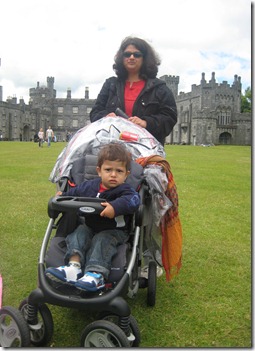
There is an official guided tour of the castle for the visiting tourists. But before the tour we decided to take lunch as everybody was feeling hungry after the long drive from Dublin. We spread our picnic sheets on the beautiful gardens overlooking the castle and had lunch together. The kids were hungry but they were more interested running around the gardens but the tasty food had brought them back soon. After the lunch we started with the annotated tour of Castle beginning at the entrance gateway to the courtyard, this is designed to complement the official self guided tour. The guidebook follows the tour, room by room, providing additional insights to the architecture, decoration, furnishings, and paintings of the castle. It also covers intriguing medieval spaces and features beneath the ground floor of the present building, which are not included in the official guided tour. Unfortunately the photo shoot is not allowed so its not possible to take pictures of the beautifully restored bedrooms and meeting rooms inside the Castle. The tour gives a glimpse of the life at kingly castle in medieval times. The exit of the tour takes you into the well groomed castle gardens on the west side of the castle. Its a beautiful garden with axial paths radiating from a central fountain and retains much of the basic form that could have been there during the ducal period. The existing fountain is probably the base of an original seventeenth century water feature. Two lead statues stand on pedestals near the castle: one is of Hermes after the original in the Vatican Collection, and the other is of Diana the Huntress. All of the garden features, including the terracing, have been recently restored. The children liked the garden a lot and wanted to stay there for more but we decided to drive over to our next stop.
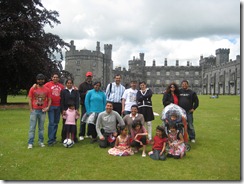
The next stop was Dunmore Cave which is eleven kilometers north of Kilkenny City and, is formed by limestone which was laid down over 300 million years ago. It contains almost a quarter of a mile of passages and at its deepest point is 150 foot below the surface. The beauty and magic of its calcite formations as well as its scientific and historical interest make it one of Ireland’s most fascinating caves. Its presence has been known for years but it is only recently that attempts have been made to unravel its history. In 928, the Dunmore Cave was the site of a Viking massacre. Mention of the cave was made in the 9th century Irish Triads.


Since 1940, when the cave became property of the State, it has been a National Monument because of its historic interest. Today, stairs and walkways and an extensive lighting system have been installed to aid access and viewing. There is restricted plant and animal life in and around the cave primarily due to the lack of sunlight. The cave did at one time support a bat colony and bat skeletons can be seen encrusted in the calcite limestone. The tour starts with a small film that provides basic information on how the caves and caves in general were formed. The tour is very well done and took about 50 minutes and involved a lot of stairs to go in and come back out, but you were well prepared for it before entering. The guide explained in detail how the caves were formed and its historical importance that how the cave is known in Old Irish literature as one of the darkest places in Ireland and as the place where the monster Luchtigern ‘The Lord of the Mice’ was slain, this cave was plundered by Godfry and the Vikings of Dublin in 928. In this raid, 1,000 people were killed, and the numerous human bones found in the cave are thought to be the remains of the victims.
The cave is divided into three main parts, of which Haddon Hall and chambers leading off it are difficult to access. The wide entrance shaft leads to the second part, which is the main chamber. Ahead lies a high chamber which is practically a cul-de-sac, while the portion to the left has a floor of eccentric blocks and a stalagmite on the east wall. From here an ascent leads to the third part, the chamber with the ‘Market Cross’ – a huge stalagmite in the middle of the triangular chamber. To the right and left of the chamber are other dripstone formations, and the blocks forming the floor are covered in stalagmite bosses.

All of us including children were intrigued by the natural beauty inside the cave but were too tired after coming out of the caves as there were hundreds of stairs to climb up and down.
After visiting a man made castle and a natural cave in a single day we were left to wonder which was more beautiful and intriguing but thankfully we don’t have to choose between them and can enjoy the splendor of both the monuments.


The drive back to Dublin was again a pleasant one and after a heavenly day in Kilkenny we went to bed mesmerized by its beauty….




 Tarun's Blog