
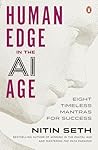
 Human Edge in the AI Age: Eight Timeless Mantras for Success by Nitin Seth
My rating: 3 of 5 stars
AI is bringing a seismic shift in our lives. Apart from disrupting industries it is also redefining concepts like work, value and intelligence. The author is proposing an eight dimensional framework called POSSIBLE which can enable humans to remain relevant in-spite of AI now learning, deciding and simulating most of the human activities at much greater pace.
In this framework author is proposing eight mantras which can help humans have an edge in an AI age
1) P: Enhance Problem Solving Skills
2) O: Openness to Change
3) S: Connect with Self through Spirituality
4) S: Learn Teamwork and Resilience from Sports
5) I: Make an Impact
6) B: Find the Right Balance
7) L: Unleash the Leader within you
8) E: Be an Entrepreneur
Most of these mantras are common knowledge and self evident but the author has tried to put these into a practical framework that can be acted upon.
First two mantras are about honing your problem solving skills through critical thinking and willingness to change the status quo.
Third mantra is where author has tried to blend the modern Western concepts with the ancient knowledge from Hindu texts to make his point. He believes that being more aware and being spiritual will give us an edge in AI age with its relentless digital stimulations, hyper-productivity and material success. He says that instead of being on an ever running treadmill of desires and expectations we should instead we should recognise immaterial reality, the soul and superconsciousness. AI will operate on material plane so to have an edge over it we need we need to go beyond material walls and get spirituality balance. To do this we need to approach action or Karma with the objective of Dharma or righteousness instead of Artha or material wellbeing. Also following the teachings of Bhagavad-Gita we need to be dispassionate about the outcomes of our actions. Also we need to be aware of inaction. Even if it is difficult and seemingly uncontrollable situation, one needs to be act with courage and get on with actions in their control. To attain this state of equanimity, author has proposed eleven laws of spirituality
1) Infinite potential and unique purpose in life
2) Living in the present moment
3) Duality and law of intention
4) Law of karma
5) Dissolving your ego
6) Discipling the senses
7) Giving before getting
8) Taking responsibility and increasingly levels of consciousness
9) Inside-out wisdom
10) Understand the flow
11) Daily habit of dharma
Fourth mantra is bit of an outlier as author is proposing that to get an edge in AI age, sport can help us in developing key skills of teamwork and resilience. He tried but could not present a convincing argument.
The last four are about inculcating the independent streak in life by honing leadership and entrepreneurship skills. Nothing much ground breaking there.
There is a chapter on Wisdom in AI age which was quite interesting as part of first mantra but ideally should have separate section as that is the crux of alignment challenge in AI age. Wisdom has captivated humans since antiquity; all agnostic faiths have placed wisdom at the core of their philosophies. Ancient Sumerians worshipped ‘Nanna’ as the god of wisdom, Hindu religion has Ganesha as their god of wisdom. There was an acceptance that gaining wisdom is not easy and involves years of learning, experiencing and reflecting. There has always been a great premium for the people who are deemed wise.
Author says that In this age of AI, wisdom isn’t just helpful but is essential. Wisdom is a multifaceted concept with different disciplines contextually offering different definitions. Also, conceptually wisdom deals with intangibles and can’t be measured, we’ll never be able to conclude that AI is as wise as a human or half as wise as a human. Unwrapping wisdom as a concept will help to place it appropriately inside the plane of immanence for AI. Numerous attempts have been made to define wisdom from different perspectives. The Cognition-based definition anchors wisdom in critical thinking, sound judgement, knowledge, experience and insight, emphasizing the pursuit of deeper meaning. On the other hand, personality-focussed definition emphasises behaviours like compassion, reflection, open-mindedness and humility. Then there is development-focussed definition which approaches wisdom as a product of life experiences and personal growth coming from active reflection.
AI with its powerful ability to process vast datasets, generate insights and pattern matching is much better placed to acquire wisdom. Humans can look at different datasets and generate insights from each one of them but struggle to connect dots and identify patterns between insights from different datasets. AI excels in that, its ability of data-interpretation as well as pattern matching is a factor far better than humans. Wisdom has to do with pattern recognition and AI with its unique ability to recognize patterns has the ability to be wiser than humans.
Traditionally we’ve used DIKW model of knowledge hierarchy for understanding wisdom, which stands for Data, Information, Knowledge and Wisdom. DIKW model was proposed by Russell Ackoff and resurfaced widely in 1980s with the advent of digital age primarily to manage information overload. The DIKW model proposes a step-by-step progression i.e. data generates information with context and structure, information leads to knowledge and knowledge eventually results in wisdom. AI today can process data as collection of facts, figures ad observations and is able to transform it into information by organizing and structuring it inti ‘what’, ‘who’, ‘where’ and ‘when’. AI is also able to delve deeper into the ‘why’ and ‘how’ aspects, analysing patterns and gaining some insights from the information. But it struggles to reach the pinnacle of DIKW hierarchy and acquire wisdom to make sound judgements and ethical decisions.
Overall a book with a unique premise but falls short in execution. Most of the information in the book is readily available and some key points have not been convincingly articulated. Author could have focussed more on the spiritual wellbeing and wisdom aspects of the age argument and proposed a way to solve the AI alignment problem from both AI and human perspectives, that would have made this book much more meaningful in the broader context.
View all my reviews
- Follow Tarun's Blog on WordPress.com
-
Recent Posts
Categories
Goodreads
Archives

