One day a tourist comes to the only hotel in a debt ridden town. Lays a $100 note on the table & goes to inspect the rooms. Hotel owner takes the note & rushes to pay his debt to the butcher. Butcher runs to pay the pig farmer. Pig farmer runs to pay the feed supplier. Supplier runs to pay the prostitute, who in these hard times gave her services on credit. Hooker then runs to pay off her debt to the hotel owner for the rooms she rented for her clients. Hotel owner then lays the $100 note back on the counter. The tourist comes down, takes his money & leaves as he did not like the rooms. No one earned anything. But the town is now without debt & looks to the future with a lot of optimism. And that is how the world is doing business today…
1. “What a computer is to me is the most remarkable tool that we have ever come up with. It’s the equivalent of a bicycle for our minds.” (film “Memory & Imagination,” 1990)
2. “I end up not buying a lot of things, because I find them ridiculous.” (The Independent, 2005)
3. “I think death is the most wonderful invention of life. It purges the system of these old models that are obsolete.” (Playboy, 1985)
4. “People think focus means saying yes to the thing you’ve got to focus on. But that’s not what it means at all. It means saying no to the hundred other good ideas that there are. You have to pick carefully. I’m actually as proud of the things we haven’t done as the things I have done. Innovation is saying no to 1,000 things.” (Apple Worldwide Developers’ Conference, 1997)
5. “Being the richest man in the cemetery doesn’t matter to me. … Going to bed at night saying we’ve done something wonderful — that’s what matters to me.” (CNNMoney/Fortune, 1993)
6. “My job is not to be easy on people. My job is to make them better.” (CNNMoney/Fortune, 2008)
7. “If you want to live your life in a creative way, as an artist, you have to not look back too much. You have to be willing to take whatever you’ve done and whoever you were and throw them away.” (Playboy, 1985)
8. “Innovation distinguishes between a leader and a follower.” (“The Innovation Secrets of Steve Jobs,” 2001)
9. “My model for business is the Beatles. They were four guys who kept each other’s kind of negative tendencies in check. They balanced each other, and the total was greater than the sum of the parts. That’s how I see business: Great things in business are never done by one person. They’re done by a team of people.” (“60 Minutes,” 2003)
10. “I would trade all my technology for an afternoon with Socrates.” (Newsweek, 2001)
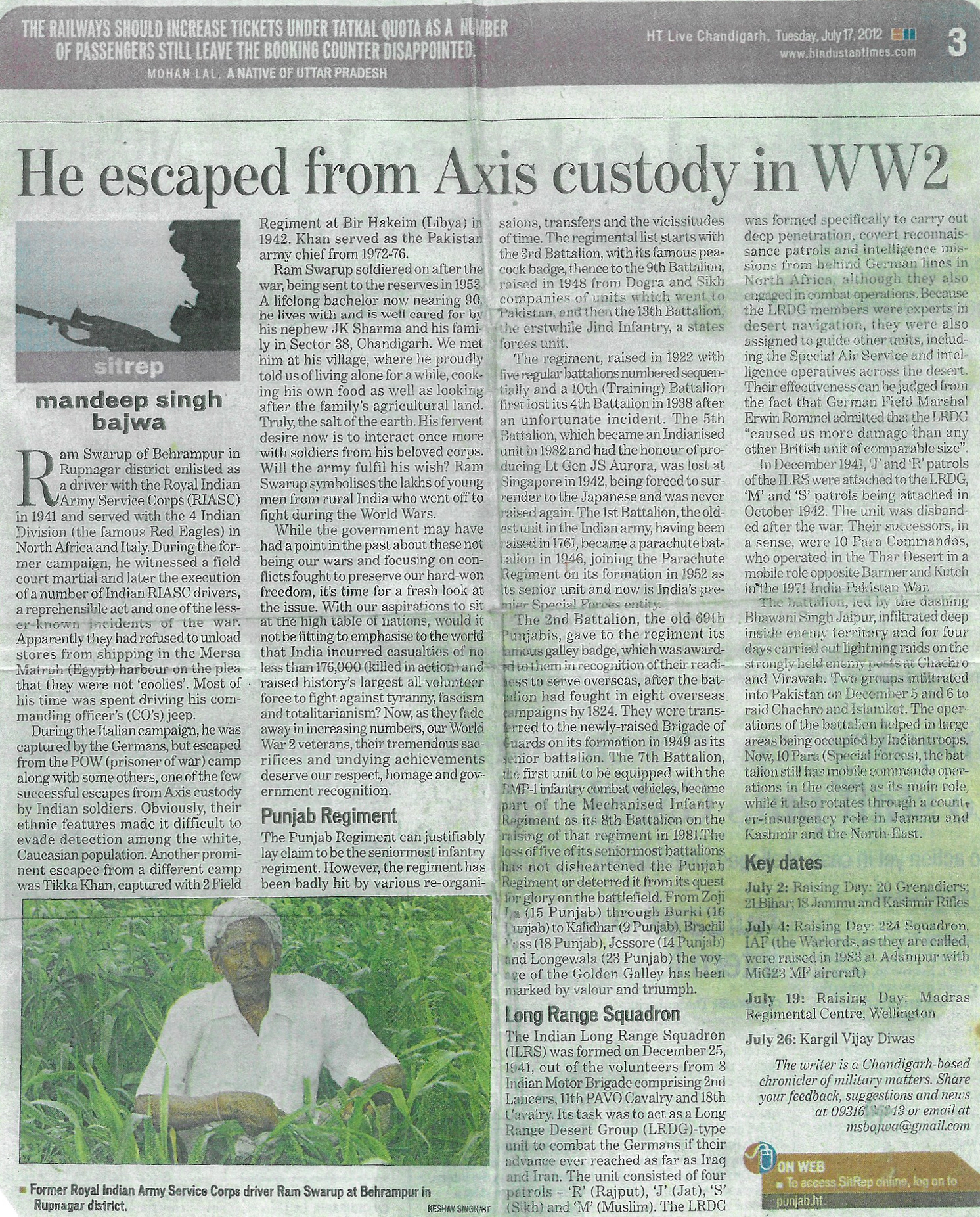
This is the story of my grand father’s younger brother as published in Hindustan Times Chandigarh , July 16, 2012. He is still alive and I always look forward to meet him whenever I visit India.
Ram Swarup of Behrampur in Rupnagar district enlisted as a driver with the Royal Indian Army Service Corps (RIASC) in 1941 and served with the 4 Indian Division (the famous Red Eagles) in North Africa and Italy. During the former campaign, he witnessed a field court martial and later the execution of a number of Indian RIASC drivers, a reprehensible act and one of the lesser-known incidents of the war.
Apparently they had refused to unload stores from shipping in the Mersa Matruh (Egypt) harbour on the plea that they were not ‘coolies’. Most of his time was spent driving his commanding officer’s (CO’s) jeep.
During the Italian campaign, he was captured by the Germans, but escaped from the POW (prisoner of war) camp along with some others, one of the few successful escapes from Axis custody by Indian soldiers.
Obviously, their ethnic features made it difficult to evade detection among the white, Caucasian population. Another prominent escapee from a different camp was Tikka Khan, captured with 2 Field Regiment at Bir Hakeim (Libya) in 1942. Khan served as the Pakistan army chief from 1972-76.
Ram Swarup soldiered on after the war, being sent to the reserves in 1953. A lifelong bachelor now nearing 90, he lives with and is well cared for by his nephew JK Sharma and his family in Sector 38, Chandigarh. We met him at his village, where he proudly told us of living alone for a while, cooking his own food as well as looking after the family’s agricultural land.
Truly, the salt of the earth.
His fervent desire now is to interact once more with soldiers from his beloved corps.
Will the army fulfil his wish?
Ram Swarup symbolises the lakhs of young men from rural India who went off to fight during the World Wars.
While the government may have had a point in the past about these not being our wars and focusing on conflicts fought to preserve our hard-won freedom, it’s time for a fresh look at the issue.
With our aspirations to sit at the high table of nations, would it not be fitting to emphasize to the world that India incurred casualties of no less than 176,000 (killed in action) and raised history’s largest all-volunteer force to fight against tyranny, fascism and totalitarianism? Now, as they fade away in increasing numbers, our World War 2 veterans, their tremendous sacrifices and undying achievements deserve our respect, homage and government recognition.
Punjab Regiment The Punjab Regiment can justifiably lay claim to be the senior most infantry regiment. However, the regiment has been badly hit by various re-organizations, transfers and the vicissitudes of time.
The regimental list starts with the 3rd Battalion, with its famous peacock badge, thence to the 9th Battalion, raised in 1948 from Dogra and Sikh companies of units which went to Pakistan, and then the 13th Battalion, the erstwhile Jind Infantry, a states forces unit.
The regiment, raised in 1922 with five regular battalions numbered sequentially and a 10th (Training) Battalion first lost its 4th Battalion in 1938 after an unfortunate incident. The 5th Battalion, which became an Indianised unit in 1932 and had the honour of producing Lt Gen JS Aurora, was lost at Singapore in 1942, being forced to surrender to the Japanese and was never raised again.
The 1st Battalion, the oldest unit in the Indian army, having been raised in 1761, became a parachute battalion in 1946, joining the Parachute Regiment on its formation in 1952 as its senior unit and now is India’s premier Special Forces entity.
The 2nd Battalion, the old 69th Punjabis, gave to the regiment its famous galley badge, which was awarded to them in recognition of their readiness to serve overseas, after the battalion had fought in eight overseas campaigns by 1824.
They were transferred to the newly-raised Brigade of Guards on its formation in 1949 as its senior battalion. The 7th Battalion, the first unit to be equipped with the BMP-1 infantry combat vehicles, became part of the Mechanised Infantry Regiment as its 8th Battalion on the raising of that regiment in 1981.
The loss of five of its senior most battalions has not disheartened the Punjab Regiment or deterred it from its quest for glory on the battlefield. From Zoji La (15 Punjab) through Burki (16 Punjab) to Kalidhar (9 Punjab), Brachil Pass (18 Punjab), Jessore (14 Punjab) and Longewala (23 Punjab) the voyage of the Golden Galley has been marked by valour and triumph.
Long Range Squadron The Indian Long Range Squadron (ILRS) was formed on December 25, 1941, out of the volunteers from 3 Indian Motor Brigade comprising 2nd Lancers, 11th PAVO Cavalry and 18th Cavalry. Its task was to act as a Long Range Desert Group (LRDG)-type unit to combat the Germans if their advance ever reached as far as Iraq and Iran.
The unit consisted of four patrols – ‘R’ (Rajput), ‘J’ (Jat), ‘S’ (Sikh) and ‘M’ (Muslim). The LRDG was formed specifically to carry out deep penetration, covert reconnaissance patrols and intelligence missions from behind German lines in North Africa, although they also engaged in combat operations.
Because the LRDG members were experts in desert navigation, they were also assigned to guide other units, including the Special Air Service and intelligence operatives across the desert. Their effectiveness can be judged from the fact that German Field Marshal Erwin Rommel admitted that the LRDG “caused us more damage than any other British unit of comparable size”.
In December 1941, ‘J’ and ‘R’ patrols of the ILRS were attached to the LRDG, the other two patrols (‘M’ and ‘S’) being attached in October 1942. The unit was disbanded after the war. Their successors, in a sense, were 10 Para Commandos, who operated in the Thar Desert in a mobile role opposite Barmer and Kutch during the 1971 India-Pakistan War.
The battalion, led by the dashing Bhawani Singh Jaipur, infiltrated deep inside enemy territory and for four days carried out lightning raids on the strongly held enemy posts at Chachro and Virawah. Two groups infiltrated into Pakistan on December 5 and 6 to raid Chachro and Islamkot. The operations of the battalion helped in large areas being occupied by Indian troops.
Now, 10 Para (Special Forces), the battalion still has mobile commando operations in the desert as its main role, while it also rotates through a counter-insurgency role in Jammu and Kashmir and the North-East.
Key dates July 2: Raising Day: 20 Grenadiers; 21 Bihar; 18 Jammu and Kashmir Rifles July 4: Raising Day: 224 Squadron, IAF (the Warlords, as they are called, were raised in 1983 at Adampur with MiG23 MF aircraft) July 19: Raising Day: Madras Regimental Centre, Wellington July 26 Kargil Vijay Diwas
Yahoo! began as a student hobby and evolved into a global brand that has changed the way people communicate with each other, find and access information and purchase things. The two founders of Yahoo!, David Filo and Jerry Yang, Ph.D. candidates in Electrical Engineering at Stanford University, started their guide in a campus trailer in February 1994 as a way to keep track of their personal interests on the Internet. Before long they were spending more time on their home-brewed lists of favourite links than on their doctoral dissertations. Eventually, Jerry and David’s lists became too long and unwieldy, and they broke them out into categories. When the categories became too full, they developed subcategories … and the core concept behind Yahoo! was born.
The Web site started out as “Jerry and David’s Guide to the World Wide Web” but eventually received a new moniker with the help of a dictionary. The name Yahoo! is an acronym for “Yet Another Hierarchical Officious Oracle,” but Filo and Yang insist they selected the name because they liked the general definition of a yahoo: “rude, unsophisticated, uncouth.” Yahoo! itself first resided on Yang’s student workstation, “Akebono,” while the software was lodged on Filo’s computer, “Konishiki” – both named after legendary sumo wrestlers.
Jerry and David soon found they were not alone in wanting a single place to find useful Web sites. Before long, hundreds of people were accessing their guide from well beyond the Stanford trailer. Word spread from friends to what quickly became a significant, loyal audience throughout the closely-knit Internet community. Yahoo! celebrated its first million-hit day in the fall of 1994, translating to almost 100 thousand unique visitors.
Due to the torrent of traffic and enthusiastic reception Yahoo! was receiving, the founders knew they had a potential business on their hands. In March 1995, the pair incorporated the business and met with dozens of Silicon Valley venture capitalists. They eventually came across Sequoia Capital, the well-regarded firm whose most successful investments included Apple Computer, Atari, Oracle and Cisco Systems. They agreed to fund Yahoo! in April 1995 with an initial investment of nearly $2 million.
Realizing their new company had the potential to grow quickly, Jerry and David began to shop for a management team. They hired Tim Koogle, a veteran of Motorola and an alumnus of the Stanford engineering department, as chief executive officer and Jeffrey Mallett, founder of Novell’s WordPerfect consumer division, as chief operating officer. They secured a second round of funding in Fall 1995 from investors Reuters Ltd. and Softbank. Yahoo! launched a highly-successful IPO in April 1996 with a total of 49 employees.
Today, Yahoo! Inc. is a leading global Internet communications, commerce and media company that offers a comprehensive branded network of services to more than 345 million individuals each month worldwide. As the first online navigational guide to the Web, http://www.yahoo.com is the leading guide in terms of traffic, advertising, household and business user reach. Yahoo! is the No. 1 Internet brand globally and reaches the largest audience worldwide. The company also provides online business and enterprise services designed to enhance the productivity and Web presence of Yahoo!’s clients. These services include Corporate Yahoo!, a popular customized enterprise portal solution; audio and video streaming; store hosting and management; and Web site tools and services. The company’s global Web network includes 25 World properties. Headquartered in Sunnyvale, Calif., Yahoo! has offices in Europe, Asia, Latin America, Australia, Canada and the United States.
Oracle FSS has officially launched its new core banking system, now dubbed the Oracle Banking Platform (OBP). First reported in IBS earlier this year and with a working name of the New Generation Banking System (IBS, March 2012, Oracle prepares New Generation Banking System), the supplier is claiming a first live site. This is UBank, the start-up entity of NAB in Australia. Another Australian bank, Suncorp, is also involved. The system is based on Java and Oracle Fusion, is intended to complement the supplier’s long-standing universal banking flagship, Flexcube, and is particularly aimed at tier one banks.
The development started around three years ago, says Ashwin Goyal, SVP, financial services at Oracle FSS. There were a few drivers. First, Oracle felt there was pent up demand at the top end of the market, with banks wanting to bring about a transformation and phased replacement of their inflexible, costly legacy systems. Those systems had been built when ‘banking was easy’, with a limited product set and largely branch delivery. Today’s market is much more driven by the customer, in terms of when they bank, where they bank and what kinds of products they take.
The most likely replacement route is expected to be through components, bringing a ‘progressive transformation’. Such componentisation was now felt to be possible but needed a ‘ground-up’ approach to produce components that were genuinely loosely coupled. Goyal believes this will be an area where Oracle will have a clear advantage with OBP. The system uses the Oracle technical footprint and middleware as well as harnessing application components, for CRM (Siebel, now Oracle CRM on Demand), data management, risk management (Oracle Financial Services Analytical Applications, which incorporates a range of solutions, including the I-flex Solutions-derived Reveleus), and financial management (Oracle’s Financial Accounting Hub, which is effectively a thick sub-ledger). However, he emphasises that OBP is a brand new development, with no reuse of Flexcube code. UBank is not running on any Flexcube components, he states.
Another driver was Oracle’s aim to move into the mission-critical arena, so working at the board level with the CEO as well as in its traditional technical domain of the CIO. Goyal rejects the suggestion that the decision to build OBP stems from any disappointment at Oracle around the inability to move with Flexcube into larger banks, gain a broader footprint and penetrate North America, as was planned at the time of the acquisition of I-flex Solutions (IBS, August 2007, I-flex and Oracle aim for ‘out-of-the-box’ banking). ‘The drivers for OBP were not so much unfulfillment of our original plan or any kind of drawback in what we had.’ It took the best learnings from Flexcube, Oracle’s application portfolio and Oracle’s technical portfolio. ‘Fundamentally, we believe none of our competitors are solving like this.’
It was felt important to have a couple of ‘charter customers’ so that Oracle was not sitting in an ‘ivory tower’, developing a system and then bringing it to market to see the reaction. NAB has been involved for the last three years and Suncorp more recently. Both were initially touted as taking Flexcube (IBS, December 2009, Flexcube R10 gains breakthrough live sites; IBS, January 2012, Suncorp to replace CSC Hogan with Flexcube) and, indeed, were reported to IBS by Oracle FSS as Flexcube recruits for the IBS Sales League Table. When Goyal says there has been some ‘misinformation’ about these clients, it is easy to see where this has come from. However, UBank, which launched in August, now has around 300,000 customers and is ‘100 per cent on OBP’. ‘NAB has laid the foundation for the rest of the bank,’ he says. It has mostly in-house systems and has plans to bring its core domestic business onto the new platform. This is why it took OBP for UBank, rather than Flexcube.
Suncorp is looking at replacing a heavily customised version of the mainframe-based Hogan system, which now resides with CSC. It has completed a first phase centred on providing a new CRM system for all business users (so using what was Siebel) and has started on phase two, which will be OBP to replace Hogan. The bank’s project is touted as a ‘bank simplification programme’
There are no other customers at present but a strong pipeline, says Goyal. Initial focus has been Australasia and North America and Oracle is ‘seeing traction’.
There has been significant work to build the banking business processes including core aspects such as managing the way products are manufactured and priced, limits and collateral management to a customer level, and CRM. There has also been work to ensure that those processes are ‘end-to-end’, from targeting a customer to fulfillment and servicing, including across the non-OBP Oracle components. And there has been work at the middleware level, including making changes to Oracle Fusion to ensure it meets the needs of a banking platform, in areas such as Service Oriented Architecture (SOA), BPEL, security, the development framework and optimising the hardware.
For purely the banking application portion, there has been a team of up to 500 engineers, mostly drawn from the Flexcube team. There has been no reuse of Flexcube apart from some limited functional designs for generic banking tasks, says Goyal. Fundamentally, Flexcube is an integrated, ‘bank-in-a-box’ solution, rather than the loose components of OBP, he says. And in Flexcube much of the business logic is in the database layer as opposed to OBP, where it is all in the channel and middleware layers.
Flexcube and OBP solve problems for very different types of needs so are very complementary, says Goyal. ‘We are expanding the pie we are going after.’ The company will continue to invest in Flexcube, he says. Despite diverting considerable Flexcube resources to the development of OBP, the existing system appears to have taken something of a leap forward of late with Release 12 (IBS, May 2012, Oracle FSS announces Release 12 of Flexcube). For ‘pure play’ commercial banking and universal banking, Flexcube will be the route forward, he says, and it also has the benefit of having been tailored for 125 or so countries. For commercial banking, Oracle FSS’s stand-out deal for Flexcube this year has been the multi-site win at Wells Fargo (IBS, July 2012, Wells Fargo takes Flexcube for global business). ‘For the vast majority – for almost all deals we will encounter – it will be very clear to us upfront whether to lead with OBP or Flexcube.’ For the few where it is not, there is a standard internal process being put in place to allow the company to make the right call.
The first release of OBP is primarily retail in focus, for deposits and lending. There is a new origination front-end which can also sit in front of third party systems. Generally, Oracle has started with simple retail products and will extend into more complex ones, says Goyal, turning to SME banking and moving on from there. Each iteration will also deepen the existing business components, he says. There is support for self-service (web, mobile etc), branch, call centre and third party channels. UBank is mainly focused on direct channels but Suncorp’s roll-out will include the branch, as will that of NAB. With payments, ‘the way we have designed it is we are expecting banks to have some sort of enterprise payments hub that we would interface to.’
OBP is also touted as customer-centric and with industrialised processes. They have been defined, built and documented in a process library and this is likely to be the starting point for projects, he feels. Taking mortgage processing, for instance, from 45 steps to three is where a lot of benefits will come, not from a straight replacement of the existing system and processes.
As with Oracle’s overall policy, there will be a role for partners with OBP. ‘It is 100 per cent aligned with how Oracle brings all its applications to market,’ not least because of the expected size and scope of the transformation programmes. ‘It is very partner-friendly because it is all standards-based.’ It is written in Java with Java-based extensibility, including with Oracle’s JDeveloper and Eclipse, and there will be a strong emphasis on retaining a standard version with minimal customisation. Three system integrators have been in talks with Oracle and have started to invest resources, says Goyal. These are Accenture, Capgemini and IBM. Benchmarks are at the planning stage, with the expectation that the results will be announced in early 2013.
The work has been challenging, says Goyal, but Oracle is more or less where it wanted to be when it set out on the development three years ago. At the same time, it is known that NAB’s overall project has gone over budget and is behind schedule.
BOSS :- अगर मेरे हवाई जहाज़ में 50 ईंटे हो और मैं एक नीचे फ़ेंक दूं तो कितने बचेंगे ?
Employee :- 49
BOSS :- तीन वाक्य में बताओ कि हाथी को फ्रीज़ में कैसे रखा जाये ?
Employee :- (1) फ्रीज़ खोलिए, (2 ) हाथी को उसमे रखिये और (3) फ्रीज़ बंद कर दीजिये !
BOSS :- अब 4 वाक्य में बताओ कि हिरन को फ्रीज़ में कैसे रखा जाये ?
Employee :- (1) फ्रीज़ खोलिए (2 ) हाथी को बाहर निकालिए (3 ) हिरन को अन्दर रखिये और फिर फ्रीज़ बंद कर दीजिये !
BOSS :- आज जंगल में शेर का जन्मदिन मनाया जा रहा है, वहां एक को छोड़ कर सब जानवर मौजूद है, बताओ कौन गैरमौजूद है ?
Employee :- हिरन, क्योंकि वो फ्रीज़ में बंद है !
BOSS :- बताओ, एक बूढी औरत मगरमच्छो से भरी तालाब को कैसे पार कर सकती है ?
Employee :- बड़े आसानी से, क्योंकि सारे मगरमच्छ शेर के जन्मदिन के पार्टी में गए हैं !
BOSS :- अच्छा आखिरी सवाल, वो बूढी औरत मर कैसे गयी ?
Employee :- hmmmmm ……. लगता है सर कि वो तालाब में फिसल गयी अथवा गिर गयी होगी ….. Errrrrrrrrrrr..
BOSS:- अबे गधे, उसके सिर पर ईंट लगी थी जो मैंने Airplane से फेंकी थी, यही problem है कि तुम अपने काम में जरा भी ध्यान नहीं लगाते हो और तुम्हारा दिमाग कही और रहता है, You should always be focused on your job ! Understand ?
(Moral:- जितना मर्ज़ी PREPARE कर लो,अगर बॉस ने ठान ली है कि उसने तुम्हारी बजानी है तो बजा के रहेगा)

![601239_10150834389696456_1539737909_n[1]](https://tarunrattan.com/wp-content/uploads/2012/10/601239_10150834389696456_1539737909_n11.jpg "601239_10150834389696456_1539737909_n[1]")


 Tarun's Blog