Texas, the lone star state, has been romanticised in so many Hollywood westerns like “Unforgiven”, “The Alamo” and also in neo noirs like “Kill Bill”, “No Country for Old Men“. Everything’s bigger in Texas, or so the saying goes. It is, after all, the second largest state in America – and the landscape, the politics, football games, even the food, all follow suit. Maybe that’s why it’s on-screen representations have often been larger than life, too. I’d always been fascinated by such depiction of this mysterious southern state and when an opportunity came my way knocking to visit it, I grabbed it immediately.
Texas is the second largest state in US not only by area but by population too and shares borders with the U.S. states of Louisiana to the east, Arkansas to the northeast, Oklahoma to the north, New Mexico to the west, and Mexico to the southwest, while the Gulf of Mexico is to the southeast. When Europeans arrived in the Texas region, there were several races of Native peoples divided into many smaller tribes. They were Caddoan, Atakapan, Athabaskan, Coahuiltecan & Uto-Aztecan. The name Texas derives from táyshaʔ, a word in the Caddoan language of the Hasinai, which means “friends” or “allies”.
We were looking forward to our trip, in the days leading up to the trip we completed some shopping for the gifts for family and friends and also clothes for the warm weather in Texas. In Dublin we hardly ever need summer clothing but we were told to expect temperature exceeding 30 degrees centigrades. Finally the big day came and we started off quite excitedly towards the southern state.
Our first stop in Texas was Houston, we traveled via London and after a non stop flight of ten hours landed at Houston George Bush International Airport (IAH) around 7:00 PM

local time. Houston is the most populous city in Texas and the fourth most populous city in US with population as big as Dublin of around 2 million. The city is named after former General Sam Houston, who was the president of Republic of Texas and had won Texas independence from Mexico at the Battle of San Jacinto. Today Houston’s economy has a broad industrial base in energy, manufacturing, aeronautics, and transportation. Leading in healthcare sectors and building oilfield equipment, Houston has the second most Fortune 500 headquarters of any U.S. municipality within its city limits after New York city.
After clearing immigration we came out to the baggage area and found that our luggage did not arrive. When we went to airline desk to report it, we were informed that our luggage will be coming on a later flight from London next day. It was little dissappointing but still the excitement of actually standing on Texan soil lifted our spirits. We took a cab from IAH to our hotel Hilton Americas in downtown Houston which is approximately 25 minutes ride from airport. At Dublin, the temperature was almost freezing, as is always the case in late Oct but we landed at Houston in sunny warm weather with temperature around 25 degree centigrades. Houston looked like any other modern city at first glance with one of the tallest skylines showcasing its mostly postmodern architecture. Our hotel room was on 15th floor and we could see the vast city skyline from our hotel room window. Houston is recognized worldwide for its energy industry—particularly for oil and natural gas—and multiple gas fires visible on Houston skyline confirmed that status to us. Our hotel was just next to Toyota Center which is home to Houston Rockets basketball team and besides Discovery Green park. The park we explored a bit later is a beautiful green space with a kid’s area and fancy eating joints. The hotel has a Mexican Restaurant where we’d a sumptous dinner in company of other family members who were also visiting Houston for the family event. It was great to see the family and friends, some of whom we’d not seen since many many years. We were tired after our long transatlantic flight and few glasses of Sangria , we had with dinner started kicking in and off we went to bed shortly afterwards.
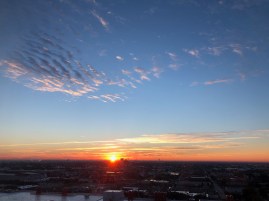 Next morning, the jet lag kicked in and we woke up around 4 o’clock in the morning. As there was no point in fighting the body clock so we decided to brew tea in the hotel room and wait it out. We pulled off our hotel windows, had tea and biscuits and slowly watched dawn slipping in. It was a cloudless sky and we were in for a great surprise as we witnessed a mesmerizing sunrise from our hotel room window.After we’d glowed in that slendour of mother nature, we got ready and went down for breakfast. Hilton service did not dissappoint as the breakfast menu was great and we made the best of it.
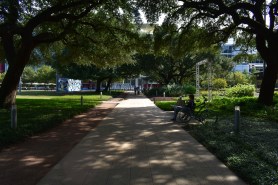 As sun was out so we decided to take a stroll in nearby Discovery Green park and explore the near vicinity of the hotel. We discovered Phonecia Food Speciality Store and Houston Shopping Centre all within walking distance of the hotel. As we still had time at hand so we decided to visit the museum district of Houston. By Uber it took us 15 minutes from our hotel. The Houston Museum District is an association of 19 museums, galleries, cultural centers and community organizations dedicated to promoting art, science, history and culture. Houston’s Museum District is walkable and bikeable. Sidewalks are wide and well-maintained, and attractions and restaurants are situated near each other.
 The biggest museum is the Houston Museum of Natural Sciences (HMNS) and consists of a central facility with four floors of natural science halls and exhibits, the Burke Baker Planetarium, the Cockrell Butterfly Center, and the Wortham Giant Screen Theatre. There is also Museum of Fine Arts which is one of biggest art museums in the world covering some 64000 works from all corners of the world spread across 30000 sq meters. The museum district has a beautiful Hermann Park at the southern end, it is an urban park spread across 445 acre green space and has zoo, theatre and few museums inside it. The park also features a large reflecting pool, numerous gardens, picnic areas, and McGovern Lake, a big 8-acre recreational lake. It was a brain child of real estate investor and entrepreneur George H. Hermann, who owned most of the area and served on the city’s parks board and bequeathed his estate to Houston for use as a public green space in 1914.
 There is also a toy train named Hermann Park Railroad that runs through the park and we decided to ride it. Tickets which are nominal can be purchased at the Hermann Park Conservancy Gift Shop at Kinder Station. Snacks are allowed on the train and we enjoyed drink & bite while we took the leisurely 25-minute ride around Hermann Park. The train makes three stops at points of interest in Hermann Park—the Houston Museum of Natural Science, Rice University near the METRORail and the Buddy Carruth Playground for All Children.
 It was a great day and the company of friends made it a memorable one. We ended the day with a three course dinner at Grove restaurant in Discovery Green Park with few pegs of Mccallan on the rocks. After dinner and few more rounds of Scotch we lipped back to our room. Around midnight we got a call from Hotel concierge that airline has finally delivered our luggage, which was a big relief for us.
Next day was spent visiting family and friends, first stop was West University place or West U, a suburb of Houston. Claudia Feldman of the Houston Chronicle described West University Place as a “wealthy city inside a city” and “a tidy, orderly community, one where furniture matches, bills get paid and accomplished parents raise accomplished children“. Almost all street names in West University Place are allusions to universities, colleges, and poets.
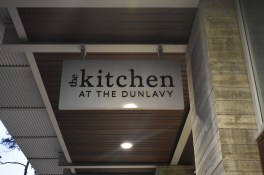
Later in the evening we attended the family function at The Dunlavy Buffalo Bayou. It’s an amazing restaurant in shape of a glass box perched up like a tree house. The interior is bright and open with thoughtful touches like chandeliers, distressed tables and unique crockery. The decor is somewhat Victorian with a modern twist and rustic tables.
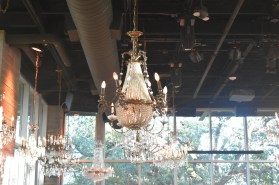 I counted 42 glittering French and Italian crystal chandeliers glowing overhead in The Kitchen at The Dunlavy – a constellation’s worth of shining facets, multiplied by the reflection in so many windows of this glass box. It was great to watch in that marvellous setting a younger member of our family making his way towards marital bliss in company of all the family & friends. The food too was great with excellent choices of wine and scotch. It was a night to remember and we’ll cherish the memories of that night for a long long time.
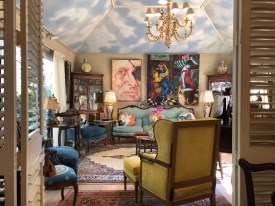 We’d a brunch next morning at one of our family friends who had an amazing house wth collectibles from all around the world. The house looked more like a museum and perfectly built for entertainment. It was a bright sunny morning and after that delicious brunch we headed our way to San Antonio in company of some our extended family. The drive is a straight shot on IH10. Depending on how fast you drive, you can get there in 3 to 4 hours. The drive is not particulary scenic, a bit boring but gives an idea of Texas landscape. Coming from Europe, one thing that stood out for us were the number of Camper van dealerships on the way. The charm of the Lone Star State comes from the fact that it’s a special blend of country and cosmopolitan. You can get a pretty good picture of Texas from the tall skylines of Houston and Dallas. But most Texans know that to really take in the Great State in all of its rugged glory, all you need to do is grab a tent and head into the wilderness. Well we thought that’s a must for our next visit to Texas, for this first time we decided to enjoy the beautiful cities of Texas and San Antonio has to be the most beautiful of all Texan cities.
Straddling the regional divide between South and Central Texas, San Antonio anchors the southwestern corner of an urban mega region colloquially known as the “Texas Triangle”. The Texas Triangle is formed by the four main cities, Houston, Dallas, San Antonio and Austin, connected by Interstate 45, 10 & 35. The area is sometimes also referred to as the Texaplex and contains 5 of the 20 biggest cities in the US, and is home to more than 70% of all Texans, with a population in excess of 15 million.
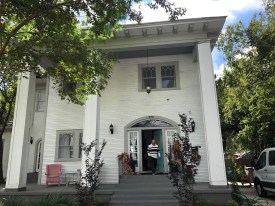 San Antonio is the seventh most populous city in the United States and the second most populous city in Texas. Founded as a Spanish mission and colonial outpost in 1718, the city became a civil settlement in 1731, making it the state’s oldest municipality. The city’s deep history is contrasted with its rapid growth: it was the fastest-growing of the top ten largest cities in the United States. We’d rented out a big house at East Craig Place which was near to tourist attractions as well as to the airport.
 We reached San Antonio late afternoon and after resting a bit at Craig place house decided to visit the famous river walk that evening. The San Antonio River Walk (also known as Paseo del Río or simply as The River Walk) is a city park and network of walkways along the banks of the San Antonio River, one story beneath the city streets. It was surreal when we climbed down from the city street to the river walk area. The city up seemed like any other city but once you reach the river walk area and see it first hand then it becomes apparent why millions visit San Antonio River Walk every year.

The place is simply out of this world, it winds and loops under bridges as two parallel sidewalks lined with restaurants and shops, connecting the major tourist draws from the Shops at Rivercenter, to the Arneson River Theatre, to Marriage Island, to La Villita, to HemisFair Park, to the Tower Life Building, to the San Antonio Museum of Art, to the Pearl and the city’s five Spanish colonial missions, which have been named a World Heritage Site, including the Alamo. During the annual springtime Fiesta San Antonio, the River Parade features flowery floats that float down the river.
We decided to first take the river cruise, our captain was quite funny and had jokes one too many for almost everything. But overall it was quite a ride and provided us an insight into the rich history of San Antonio. The boat ride lasted around an hour and by the time it was over, it was already dusk and as we were all starving after a long drive from Houston and the boat ride so we started looking for a place to eat. The River Walk looked to us to have a great night life, there were still lot of tourists on the river banks and on the boats at that time. We ended up having dinner at Little Rhein Steak House which is renowned for perfectly prepared steaks, an award-winning wine list, and its casual, rustic charm.
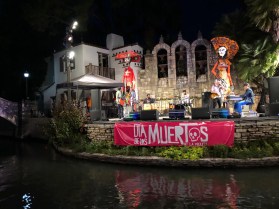 From where we were dining we could watch the band playing on a stage nearby on the river bank. It was a day well spent and we were all exhausted after our excusions and drew back to Craig place where we first launched into a fiery debate about the good and bad of Trump America over few round of scotch and then reposed for a good night’s sleep.
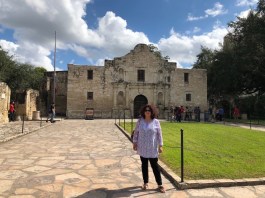 Next day we decided to visit Alamo mission. The story of the Alamo begins with the establishment of the Mission San Francisco de Solano near the Rio Grande River in 1700. There, Spanish missionary Father Antonio de San Buenaventura y Olivares worked to convert many of the Coahuiltecan bands to Catholicism. After Olivares traveled to Texas with an expedition in 1709, he was awestruck by the beauty of San Antonio area and later recommended it to the Spanish viceroy, Marques de Valero, as a site for a mission waypoint on the road to Spanish settlements in East Texas. The mission that we know today as the Alamo was born as Mission San Antonio de Valero in 1718. In response to increased French and American threats from nearby Louisiana, Spain mobilized its military into the Texas frontier after the turn of the century. Though it started as a mission, later Spanish military occupied the old mission compound and converted it into a frontier outpost and military garrison. When Mexico declared it’s independence from Spain in 1821, the Alamo remained a military outpost. The soldiers of the Alamo Company, named for their hometown Alamo de Parras south of the Rio Grande, shifted their allegiance to the newly formed independent nation of Mexico. San Antonio de Béxar was now key military point, a crossroads and center of commerce in colonial Texas. With the outbreak of revolt in Coahuila y Tejas, San Antonio resumed its old role as Texas’ capital. The Alamo, now a fortress under the command of 26-year-old William Barret Travis, came under siege by dictator Santa Anna. He ordered the pre-dawn attack on March 6, 1836 in which 186 Texians, Tejanos, Americans and Europeans sacrificed themselves to stop a tyrant. Texas won it’s independence from Mexico at the Battle of San Jacinto on April 21, 1836. But the fighting did not end there. Mexico refused to give up its claim to Texas as well as the additional territory claimed by the new Republic, and launched military attacks on Texas several times in the ensuing years. The Alamo remained a vital military garrison protecting San Antonio and supplying border forts from Mexican incursion and Indian attacks. Texas joined the United States on December 29, 1845. San Antonio de Béxar and the Alamo greatly benefitted from annexation and statehood. Centrally located and vital to Texas, San Antonio was already seen as an important civic and military asset. The Alamo became a U.S. Army outpost and depot. It was during this period that the Army added the Alamo’s famous bell-shaped top.
The Alamo today stands at the heart of San Antonio and the heart of what it means to be a Texan. People visit from all over the world to see and learn about the mission and fort’s vital role in defending freedom. Battlefield tours, living history, a one-of-a-kind movie, summer camps, unique exhibits and more are available year-round on the Alamo grounds. Only 20% of the original mission is still standing, the enterance to Alamo church and ground is free. It was pretty hot hat day, during spring and summer months, San Antonio weather is typically hot – wearing sunscreen and drinking plenty of water is recommended. We took audio tour in English, audio tours in Spanish, German, Japanese, and French are also available. It was worthwhile to hear about Alamo history and fight till death of Texan defenders and how it helped create the indomitable Texan spirit.
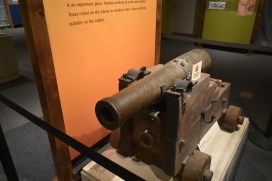 The building hosts a museum also and there we saw the famous Alamo cannon which gave Texas its famous slogan “Come and Take It” and its lone star flag. In January 1831, the request for the armament for defense of the colony of Gonzales was granted by delivery of a small used cannon. The swivel cannon was mounted to a blockhouse in Gonzales and later was the object of Texas pride. At the minor skirmish known as the Battle of Gonzales—the first battle of the Texas Revolution against Mexico—a small group of Texans successfully resisted the Mexican forces who had orders from Colonel Domingo de Ugartechea to seize their cannon.
 As a symbol of defiance, the Texans had fashioned a flag containing the phrase “come and take it” along with a black star and an image of the cannon that they had received four years earlier from Mexican officials. This was the same message that was sent to the Mexican government when they told the Texans to return the cannon; lack of compliance with the initial demands led to the failed attempt by the Mexican military to forcefully take back the cannon. We saw the replica of the original flag when we visited the Texas State Capitol next day.
 But more about Capitol later, let me first tell you more about San Antonio. We bought few sovernairs from the gift shop on Alamo grounds and then proceeded to Pearl Brewery for a quick lunch. Pearl near River Walk provides a unique experience as a top culinary and cultural destination. The mixed-use space features retail, dining, picturesque green spaces and paseos, a riverside amphitheater and educational institutions. As a former brewery operating from 1883 to 2001, Pearl reflects a vivid past while embracing the future mixed with historic architecture.
 After the lunch, I’d promised kids to show them the different museums around Alamo. We purchased a multi attraction pass for Ripley’s Haunted Adventure, Tomb Raider 3D and Guinness World Records. . The first stop was Guinness World Records museum. There are tons of laminated info lining the walls and lots of rooms, short videos of the show where ordinary people would go on to try and break current Guiness World Records and a few games. The Haunted Adventure was definitely the best. Not just because we didn’t know what to expect, but because the employee that was interacting with us was terrific! She startled and scared us and had us laughing all at once. There were few sections which were really spooky, but overall it was good silly, extravagant diversion. The last one Tomb Raider was just laser gimmicks, not much for adults but there were loads of video games for kids to play.
After the museums, we walked back to Rivercenter Mall for some shopping and then strolled along the banks of river for some time, had our pictures snapped with Saint Antonio statue on the river walk. Overall it was a great excursion and it was getting dark so we decided to head back to Craig Place house. We cooked a sumptous dinner of chicken curry, rice and rotis and afterwards enjoyed a drinking session with scotch over lively old Bollywood classics.
Next day we decided to go to Austin, capital of Texas which is roughly 80 miles via I-35 S. We started early morning after a light breakfast, the drive took around one and half hours. Austin is fastest growing city is US and has a long history. In the 1830s, pioneers began to settle the area in central Austin along the Colorado River. In 1839, the site was chosen to replace Houston as the capital of the Republic of Texas and was incorporated under the name “Waterloo“. Shortly afterward, the name was changed to Austin in honor of Stephen F. Austin, the “Father of Texas” and the republic’s first secretary of state.
 Our first stop was Lady Bird Lake which is a river-like reservoir on the Colorado River. The lake is a popular recreational area for paddleboards, kayaking etc. We drove to the wrong side of the park first and had to find our way to the Board Walk the main recreational area. The excursion on the lake was great and as it was lunch time by then we decided to have some authentic Mexican food on a Taco truck. The food was really tasty and as we had only a day to explore Austin so we headed off to Texas State Capitol which is the seat of Texas government.
Located in downtown Austin, the structure houses the offices and chambers of the Texas Legislature and of the Governor of Texas. Designed in 1881 by architect Elijah E. Myers and constructed from 1882 to 1888 the capitol is a roughly rectangular building with a four-story central block,
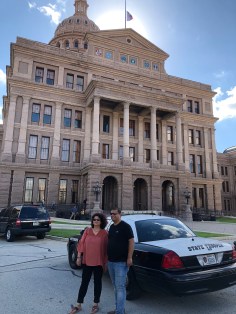 symmetrical three-story wings extending to the east and west, and a dome rising from the center. There is Goddess of Liberty statue installed atop the dome. The structure is built in an Italian Renaissance Revival style and modelled on the design of the United States Capitol, but with its exterior clad with local red granite.
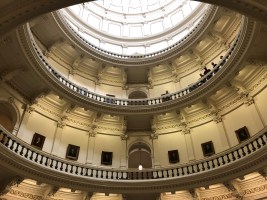 The central rotunda is hung with portraits of all the past presidents of the Republic of Texas and governors of the State of Texas; the rotunda is also a whispering gallery. We marvelled at the dome and whispered Hello Texas standing at the center of dome. The south foyer features a large portrait of David Crockett, a painting depicting the surrender of General Santa Anna at the Battle of San Jacinto, and sculptures of Sam Houston and Stephen F. Austin made by Elisabet Ney. The Texas Confederate Museum was held in a room on the first floor from its opening in 1903 until 1920, when it was moved into the General Land Office Building.
 We climbed up to first floor to see the Senate and House of representatives rooms, it was fascinating to see in person the place from where Texas government rules. Afterwards we bought soveniers from the gift shop inside Capitol and came out. The Capitol building is surrounded by 22 acres of grounds scattered with statues and monuments like the one commemorating the Heroes of the Alamo installed in 1891. Others included the Heroes of the Alamo Monument (1891), Volunteer Firemen Monument (1896), Confederate Soldiers Monument (1903) and Terry’s Texas Rangers Monument (1907), and these flank the tree-lined Great Walk. A granite monument of the Ten Commandments on the grounds of the Texas State Capitol was the topic of a 2005 U.S. Supreme Court case, Van Orden v. Perry, in which the display was challenged as unconstitutional. In late June 2005, the Court ruled that the display was not unconstitutional. We rested in that beautiful setting for some time to regain strength from the long tour of Capitol.
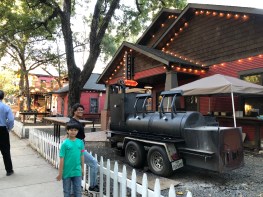 The city’s official slogan promotes Austin as “The Live Music Capital of the World“, a reference to the city’s many musicians and live music venues. We wanted to check out that side of Austin and rode up to Rainey Street to experience it first hand. Renovated houses turned into bungalow bars reign supreme on this popular tucked-away street. We found relaxed bar-goers strolling from bar to food trailer to bar again, looking for a kicked back sip and a bite. It really looked promising but it was getting late for us so with heavy heart, we had to leave the street and head back to San Antonio.
It was our last day at San Antonio and we had to catchup with our family friends at Wesley Creek, the name reminded me of American outlaw and folk icon John Wesley Hardin from the same region in Texas, who had infested creeks around San Antonio and claimed to have killed 42 men by the age of 25, wrote all about it in an infamous autobiography. But apart from that wierd connection, the place was nice and we’d great time catching up with our friends. It was already quite late when we reached back to Craig place house. It was our last day at San Antonio so we decided to have a toast for the great city and shortly afterwards went to much needed sleep.
Next morning we started early back to Houston, the trip was uneventful, but once we entered Houston, it seemed that heavens had opened up and we were greeted by the torrential rain, likes of it we had seen only back at India.
 We’d booked ourselves at Luxury Apartments, downtown Houston. The apartment was at the top 30th floor and had panaromic views of the city, even better than the view from Hilton Americas earlier. The torrential rain meant that we were stuck in the apartment for the rest of the day, we got dinner from Phoenicia and spent cosy time together and slept early.
 Next day, we’d planned to explore the River Oak district of Houston, which is named “the most expensive neighborhood” in Houston. We drove up River Oaks Boulevard, a road that runs through the center of the community, is lined on both sides by mansions and estates located away from the street. Our first stop was River Oak Shopping Centre, Houston’s first shopping center constructed in 1927. Its a long strip village style shopping area with everything in one spot. You would need your walking shoes but otherwise nice up market, not snobby place to shop. We started with Barnes & Nobles and bought few books to read at home, then went to Taverna for a delicious lunch and then did bit more shopping for clothes at Ann Taylor and Gaps. We really liked the place, with over 75 stores and restaurants, it seemed to be one-stop destination, say to browse for a special work of art, savor delicious cuisine, relax with a great new book or indulge in a shopping spree. We drove around a bit to get the feel of the district, passed Lakewood Church of Joe Osteen on our way, infact the famous pastor was born in River Oaks district of Houston. It was a day well spent and needed rest after tiring walk and headed back to our apartment to rest where we cooked our dinner and watched a movie together on Amazon Prime which was available on apartment TV. Kids were really excited for the next day as we were going to NASA Space Center Houston in the morning.
We’d been told that it would take us a whole day trip to cover Space Center so we decided to start early next morning. It was me, my wife and our two kids, one a teenager and other ten year old and we started on our Uber ride around 10 a.m. on the bright Friday morning and it took us 40 mins to reach the Space Center from Houston downtown. Kids were super excited to visit NASA facility and me and my wife being young at heart, were also looking forward to it.
 As we approached the space centre parking lot, we could see from a distance the gaint Boeing and the space shuttle latched on it, it was a mesmerizing sight. Established as the Manned Spacecraft Center (MSC) in 1961, the Lyndon B. Johnson Space Center (JSC) named in honor of the late President, is responsible for the design, development, and operation of human space flight. For more than four decades, JSC has been the world leader in human space flight operations for NASA. The MSC opened in 1963 with Gemini IV as the first flight controlled here and became a hub of activity as the Gemini program ended and the Apollo program gained momentum. The Apollo program obtained the national goal, set by President Kennedy in 1961 of landing men on the Moon and returning them safely within the decade of the 1960’s. The eyes of the world were on Houston and the MSC on July 20, 1969 as Neil Armstrong reported from the lunar surface, “Houston, the Eagle has landed.” Hours later, Armstrong descended the ladder of the Lunar Module (LM)”Eagle” proclaiming, “That’s one small step for a man, one giant leap for mankind” as he took his historic first steps on the Moon’s surface. Later, in 1973, the MSC was renamed the Lyndon B. Johnson Space Center (JSC) and has been the heart of the manned space flight program ever since. Controlling flights from Gemini, Apollo, Skylab and the Apollo-Soyuz through the current Shuttle program is the responsibility of JSC scientists, engineers, astronauts and other staff members.
 We got into the space center main hall after security check and a friendly staff member guided us on the best way to tour the facility. He suggested that we start with the open-air tram tour of Mission Control facilities to get an idea of the layout of the NASA operations and it would allow us to see an active site (the training facility in our case). The tour included Building 30 (location of the Historic Mission Operations Control Room 2 and Chris Kraft Mission Control Centers). We visited working training facilities and saw the NASA team members working on different training facilities pimarily for the ISS and also for the planned trip to MARS.
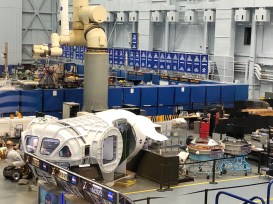
There was a team, we saw working actively on the MARS manned rover to be used by the first manned mission to MARS planned for around 2030. The Tram then took us to a memorial ground inside the space centre where a tree has been planted for every astronaut who died during mission. We could see the tree where the memory of Kalpana Chawla, an India American astronaut killed in Columbia Shittle disaster, has been kept alive.
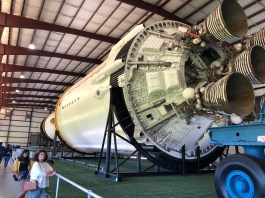 Next tram dropped us at Building 9 (location of the Space Vehicle Mockup Facility) and Rocket Park with a restored Saturn V rocket which is the most powerful rocket built by humans. The first stage of this Saturn V rocket is from SA-514 (originally intended for the cancelled Apollo 19), the second stage from SA-515 (originally intended for the cancelled Apollo 20), and the third stage from SA-513, which was not needed after it was replaced by the Skylab workshop. SA-513 was originally scheduled for the cancelled Apollo 18 – the rest of the rocket was used for Skylab). The Apollo Command/Service Module CSM-115a (intended for Apollo 19) caps the pointy end. The visit to rocket park and especially seeing the Saturn V rocket inside the holding building was really impressive (in size and impression).
 Luckily it was a Friday and center runs a “Meet An Astronaut Friday” event. We went to the theater where a retired astronaut Arnold from Apollo mission showed us slides about his space trip and talked about his career. He narrated an interesting episode where they were assigned for testing a specially built Coke can that could actually work in space and how Pepsi came to now about this Coke can testing and forced NASA to take their can as well up in space. He was a great story teller and actually it would have been better if astronauts were given enough time to actually meet everyone in the theater, I would have loved to shake hands with an actual astronaut. Though I’ve done that a few years back with a different astronautChris Hadfield when he visited Dublin on his book tour.
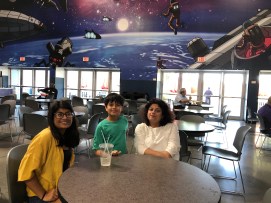 Next we decided to go to the food court which has good selection for lunch. Everybody was tired so we all rested a bit there over bite and afterwards resumed our tour with a visit to the Apollo manned missions exhibit. The highlight there is a lunar spacesuit from Apollo 12, the Command Module of Apollo 17 and moon rocks. We went inside the command module and wondered how austranauts were able to perform in such cramped space. Also experience of touching an actual moon rock was exhilarating to say the least.
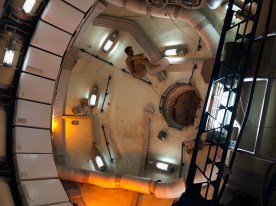
We realised that we only had few minutes left to cover Independent Plaza exhibit. This landmark attraction is the world’s only shuttle replica mounted on the original shuttle carrier aircraft and the only place where the public can enter both vehicles. The shuttle replica Independence, formerly known as Explorer, previously was located at Kennedy Space Center Visitor Complex but was moved to make way for a new permanent attraction hall for Space Shuttle Atlantis. Independence is now displayed atop the retired Shuttle Carrier Aircraft, NASA 905. It was a great expereince to walk inside an actual space shuttle, I’m really waiting for the day when ordinary people can go on space trips on a shuttle like this like we do air trips today.
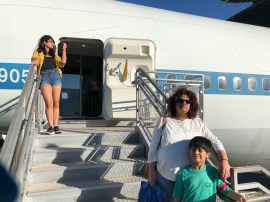 It was quite near the closing time now and we decided to visit the shop inside space centre to buy few souvenirs to cherish this visit for long. We had a wonderful time visiting the space center. There is so much history and information to be learned just by visiting. The exhibits are all very well organized with plenty of easy to read and follow signage. There were many hands on exhibits for the young and young at heart. There is so much to see, I don’t think we were able to cover everything even when we started quite early in the day. I hope that we go back again one day and relive that wonderful day.
On our last day at Texas, we decided to take it a bit easy. We originally had planned to visit Galveston, a nearby coastal town but then realized it would be a full day trip. Kids were tired after the Space Center tour so we instead went to Galleria which is the largest mall in Texas and seventh largest in whole of US. Infact Forbes ranked the Galleria as “one of the world’s best shopping malls”.
 It is an upscale mixed-use urban development shopping mall located in the Uptown District of Houston, Texas, United States. The development consists of a retail complex, as well as the Galleria Office Towers complex, two Westin hotels. With over 3 million total square feet of space that includes 375 stores anchored by Neiman Marcus, Nordstrom, Saks Fifth Avenue, and Macy’s. We did some shopping from Macy’s, went into Apple Store and Microsoft Store which were adjacent to each other. Also we visited the Tesla showroom and sat inside a brand new Model S to explore the future first hand.
 The Galleria also includes a 20,000-square-foot ice skating facility with 80 feet rink. The rink, known as “Polar Ice” was the first ever built inside a mall and is positioned below the mall’s central glass atrium. There is also a jogging track on the roof around the atrium with a view to this rink. About 50 restaurants and specialty food stores at all prices and service points are located throughout the Galleria complex. We had our lunch there at a Taco stall and savoured a really spicy curry with noodles and rice.
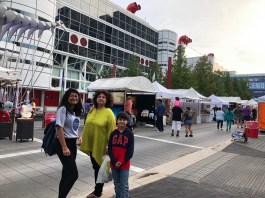 It was already late evening by the time we came back to our apartment and were tired. But kids wanted to go back to Hilton Americas from where we had started our Texas jouney. So off we went and there was a small surprise as a Saturday market was on the swing on the grounds of Discovery Green park. There were lot of stalls selling their wares, paintings etc. It was a lively environment and we liked the different stalls particularly one where a guy was selling stuff made of discarded tin boxes.
We finally made it to Hilton, sat in Starbucks and over  a cup of hot cappuccino recounted together the unforgettable moments from our great trip to Texas, different places we had covered in last few days, people we had met and things we had done. I’m sure we’ll remember these days for long time to come and talk about it many times in future too.
Next day our flight was at noon time, we started around 8:30 a.m. for the airport after a quick breakfast, checked in and boarded our flight to Washington Dulles where a conecting flight brought us back to home at Dublin. We kept talking about our trip during the flight and later back home till weeks later. Texas no doubt is a big state, it has everything, from new glistening high rises at Houston & Austin to old world charm of San Antonio, from art centres to big sport complexes, some of the best food around and best shopping districts. We loved our time at Texas and hope to visit it again sometime in future.
Tarun Rattan

 Jagad Guru Adi Shankaracharya (788-820 CE) was an early 8th century philosopher and theologian who led the revival of Hinduism and is credited with unifying and establishing the Advaita Vedanta doctrine in Hinduism. He successfully trampled the onslaught of contrarian beliefs and defeated in discourse the leading proponents of other strands of Hinduism as well as that of Buddhism, Jainism and Charvaka School. As Hinduism exists today, it is in most part due to Jagad Guru’s foresight in putting organisational structure for its perpetuation through the four mathas he established in the four corners of India at Sringeri, Dwarka, Puri and Joshimath.
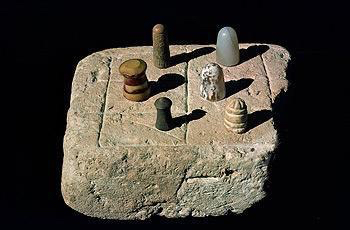
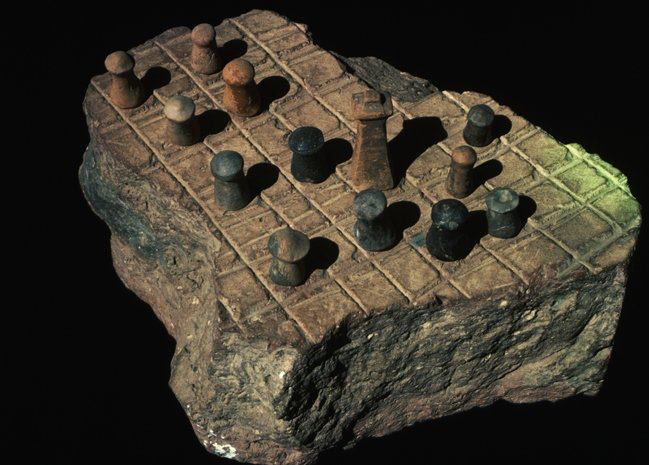 It belongs to Indus Valley Civilization and dates back to c.2300 BCE. The board was used to play an early form of Chess.
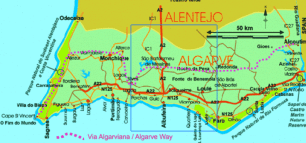 The Algarve is Portugal’s southermost region and is famous for its Atlantic beaches, soaring cliffs, sea caves and numerous golf resorts. Albufeira is a coastal city in soutern Algarve and was a former fishing village that now has become a major holiday destination. The name of Albufeira comes from the Arab “Al-Buhera” which (means “Little lake/lagoon”) – this name might have derived from the existence of a fortification built on the rocky outcrop that dominated the lagoon on the lower part of the town. Albufeira is one of the oldest cities in the Algarve, but today it has transformed itself into a “Capital of Tourism” in Portugal. It’s famous for its sunny beaches & spicy nightlife but it is also an area full of history, with vestiges of human occupation since the remote Neolithic and Bronze ages. At the start of last millenium, commerce with the North African coast led to a gradual influx of the Moors throughout the Algarve. The Arabs made great strides in the development of agriculture, introducing new cultivations, tools and techniques, such as ploughs, water wheels and intoduced the use of fertilizers. The Christian conquest of the region began at the end of the 12th Century. After decades of conflict, a tight siege of the town by the Knights of the Order of Santiago, finally drove out the Moors in 1249, in the reign of King D. Afonso III. The town was awarded to the Military Order of Aviz and became part of the kingdom of Portugal and the Algarves. King D. Manuel I awarded Charter to the Town of Albufeira on the 20th of August 1504 (date of the municipal holiday) and from that day the town was governed according to the legislation in force for the rest of the country.
 We’d arrived late at night at hotel reception, the checkin was quick and we got checked into a spacious apartment at the first floor. We were all tired after a three hour long flight, so had a quick dinner and went to sleep. The morning was bright and sunny, at night we were too tired even to have a quick look around but once we opened the curtains the day light filled in the huge balcony with good partial views of the Atlantic. As it was our first day so we decided to explore the resort and to our delight found that access to beech was just next to our apartment. The beech itself is quite scenic and we spent a great time there playing discus throws and trying our beach ball skills with kids.
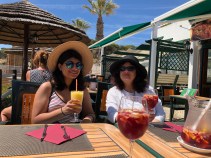 lunch just next to the beech and we settled on a lovely restaurant called Vivaldo. We took vegetarian and sea food options and had a delightful lunch with great views of the sunny beech.
 It was hot & sunny and views were amazing, we clicked a lot of photos sitting there having our lunch. After lunch we again climbed down to the beach through the wooden staircase access from the restaurant and sunbathed for a while and then had a good swim with ocean waves hitting us at speed.
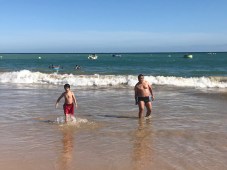 the kids. Overall it was a great day, well spent with family on a sunny beech topped by a great lunch. Later at the apartment we were too tired, but a hot shower revived us and we cooked a great dinner together and then went to a sound sleep
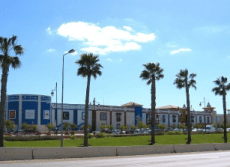 which seemed to be the favorite rainy day destination at Albufeira in online reviews. We booked an Uber from our hotel which cost around a tenner for 15 min ride to shopping centre. The centre is partially open air, so was a bit breezy but beautifully built and have tens of stores for a great shopping experience. We bought some footwear and t-shirts from Sport Zone, there’s a nice Tiger store which is always good for inexpensive small utilities, and there’s a section of the ground floor with several other clothes such as Zara, Breshka, Chicco, and Metro Kids Company. We started feeling hungry after fair bit of walking and decided to have lunch. One can be spoilt for choices for food at the centre, but all stalls seemed quite crowded. Finally we chose Pizza Hut which seemed to have some empty seating and had a big cheesie pizaa and pasta lunch together. After lunch we decided to pick up some grocery from the in-store hypermarket called Continenti. It’s a huge one and we could get everything we were looking for there. The good thing was that the hypermarket was quite near to the taxi rank so with all the heavy bags we were quickly able to get into the taxi and head back to resort. The rain had subsided by then and sun had started peeking in again. After evening tea,
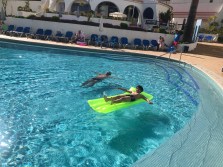 There was a continous supply of food and drinks from the restaurant on the pool and it was a great day well spent reading and snoozing with the family. Later back at the room we cooked a great dinner and spent time planning for the rest of the trip. Our teenage daughter had found out online that one could do parasailing right on the Oura beech and booking could be done just a stone throw from our hotel room and was adament to try it next morning.
 I was hoping that parasailing pestering would be over by morning but I underestimated a teenager’s tenacity to badger so we decided to give it a try and luckily for us there was a slot available, so we booked it. The prices were reasonable, an inflatable boat took us to the main boat anchored a bit off from the beech. Once we were in the main boat we were given instructions on parasailing basics. The crew prepared the parasail and then fastended her to the body harness, which is a sort of like a swing seat attached at either end to the passenger tow bar. Then the crew accelerated the boat and loosened the rope attached that slowly started taking her up the sky. The crew also recorded her ascent and captured few snaps of her doing parasailing which were later downloaded to our phones. Overall it took 40 min for the whole adventure and she was on the moon after that. The inflatable boat brought us back on the beech and atleast I was happy to get back to the safety of solid land.
 Our driver was a lovely lady who had just started the Uber driving that day and we were her first customers ever. Anyway she drove us safely to the old town which was teeming with tourists like us. Again our soccer crazy son led us to the Force Portugal shop and got us to buy him Ronaldo’s jersey. Ronando seemed to pretty popular and there were life size cutouts of him everywhere in old town, our son is a great fan on him so for him he was in a heavenly zone there. We shopped a bit in some of the numerous souvenir shops and then strolled down to the beech. After that we decided to climb to the top of the hill of the beech, but then noticed that there are escalators to take you to the top.
  Once at the top, we could see there a lovely panoramic view of the old town on one side and ocean on the other side. There was a lovely little cafe at the top which had one of the best coffee and chocalate waffles I’ve ever tasted.The sun was setting by then and it was lovely to sip coffee with the excellent views all around. It was late evening around eigth that we were back at hotel. We cooked a quick dinner and had it together with rose wine.
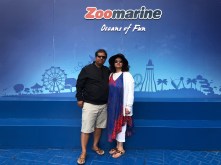 Next day we’d planned a trip to ZooMarine which is touted as the best family theme park at Algarve. The park had opened in 1991 and is located in Guia, a town near to Albufeira and it took us around 30 min to ride there with Uber at the cost of around 12 Euros. We’d booked tickets online and went straight in, the centre looked world class and has marine park with seal & dolphin shows, an aquarium & a sandy beach with slides & a wave pool. We were given a programme leaflet at the entrance and a quick browse informed us that pirate show was about to start. The good thing about ZooMarine is that all the shows and rides are free once you enter, even the water park can be enjoyed without any topups. The pirate show was funny, had some acrobatic stunts and kids loved it, it was a simple story of a pirate giving up his trade for the love of his life who then is snatched by a villain and how he rescues her with the help of his old pirate mates. I’m always afraid of the rides but kids forced me to do a roller coster ride after the show which was pretty scary and our go pro video came out just perfect for that ride. We then had a quick lunch at one of the restaurants before the highlight of the centre i.e. the Dolphin Show started.
 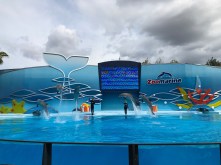 We took our seats at the Dolphin pavilion ten minutes in advance. The show was amazing, there were trainers who did lot of antics with the Bottlenose Dolphins who seemed to be following all their commands. There were jumps, dances, rides and number of tricks that dolpins performed to entertain the guests. For kids the most exciting part was when Dolphins kicked the balls towards public and there was a scramble for those balls which I’m sure those lucky kids will retain as their most precious souvenirs.
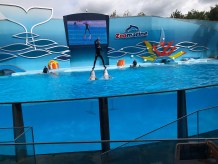 If swimming with dolphins is your dream, it will come true here at Zoomarine, the only place in Europe where you can do this, there are different unique experiences packages offered apart from the public show. As the dolphin pond is some 16 feet deep and we’re not sure how our youngest one would deal with that though he can swim ok, so instead we picked up the Dolphin Snap package where kids were able to touch the dolphins and get their pictures snapped while holding their snout.
 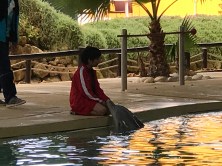 Kids were so excited afterwards that they can now boast about having held a real dolphin on their laps. Afterwards we did few more rides, then watched the parrot show which was again quite funny with parrots doing lot of silly tricks. We found Zoomarine park itself to be really interesting, lots of fun and certainly worth the entry price – and you really need the entire day to see and do it all as the attraction shows are simply amazing to watch. We didn’t use the pool or wave ride but they looked great fun & would be a must next time around. We called the Uber back to hotel which picked us from the Zoomarine entrance.
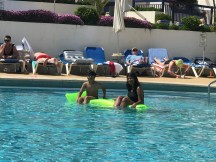 Next day was again bright and sunny, such a luxury for someone living at Ireland. We thought of getting the best of it and occupied the best sunbeds around the pool and spent the day reading, swimming, sunbathing and gulping in tons of cocktails and sleeping with warm breeze coming from Atlantic.
 This book is a light primer by an Indian politician covering the basic tenets and sacred texts of Hinduism. I’ve read Shashi Tharoor’s earlier works, some of which I can vouch to be pretty good, but this book has been such a disappointment. Actually it could have been such a topical book as there is a real demand for an easy to understand manual on Hinduism especially in the west. I’ve been asked so many times by my international friends both in west and east for a good reference book on Hinduism and there are some but none which really stands out. It’s a bigger disappointment as I feel that Shashi Tharoor is almost perfect to write that kind of book with his command over English language and his deep knowledge of Indian culture and religion.
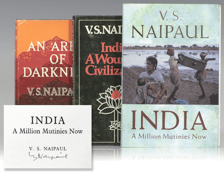 I’d read Naipaul’s India Trilogy when I was in my late teens and at that young age, it did fill me up with profound hatred for the writer who in my opinion was spewing venom against my beloved country. Naipaul and Nirad Chaudhary were the two literary villains I grew up with, though my impression of Nirad Chaudhary being utterly devoid of depth, remained the same but as I grew older, I started to admire the faculty of observation Naipaul was gifted with and also by his fearlessness to write exactly what he observed. When I heard the news of Naipaul’s demise, I decided to reread his India Trilogy as a tribute to the great writer. Naipaul died in late summer this year and I bought these books on the day of his demise but I could not start the trilogy till November, but finally have been able to complete it now.
 Tarun's Blog